Health
Lumbar Spine
This article gives an overview on what is an anterior pelvic tilt, what causes anterior pelvic tilt, and common anterior pelvic tilt symptoms.
We also address how to fix anterior pelvic tilt, including anterior pelvic tilt exercises, and anterior pelvic tilt stretches.
The pelvis connects your upper body to your legs and usually stays level with the ground. But sometimes, it tilts forward, which we call anterior pelvic tilt. This means the front of your pelvis drops and creates a curve in your lower back. Though common, an anterior pelvic tilt can affect your posture and health. In this post, we'll explain what it is, what causes it, and how you can fix it.
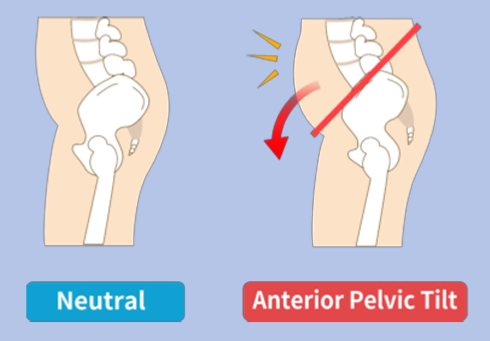
Anterior pelvic tilt is often characterized by an exaggerated arch in the lower back, a protruding stomach, and the appearance of sticking your rear end out. This can be triggered by factors like tight hip flexors, weak glutes, and poor posture. While anterior pelvic tilt is a common issue, it can disrupt your body's alignment and lead to compensatory adjustments throughout the body. These adjustments can result in changes in the way you move, create muscle imbalances, and increase the risk of getting hurt.

Some focus areas to correct for anterior pelvic tilt are core and glute strengthening - Core Exercises: Start with simple exercises, like lying on your back and practicing to flatten your lower back. You can make this more challenging by adding arm and leg movements while keeping your back flat. - Glute Exercises The glute bridge exercise has proven to be effective for APT correction. Begin by lying flat on the ground. Push your hips up, dig your heels into the ground, and support yourself with your arms

Be mindful of your posture when sitting and standing. Pay attention to avoid excessive arching in your lower back. Remember that everyone's body is different, and it's a good idea to consult with a healthcare professional or a physical therapist for personalized guidance if you're experiencing pelvic tiltrelated issues. They can assess your specific situation and recommend exercises and stretches tailored to your needs. Consistency in exercise and posture awareness can make a significant difference in correcting pelvic tilt deviations and improving your overall comfort and health.
Pelvic tilt varies a lot from person to person. In a study of 30 pelves, the angle between the bony points at the front and back of the pelvis ranged from 0 to 23 degrees, with an average of 13 degrees. Differences in bone shape alone changed that angle by up to 11 degrees between the left and right sides, which means judging tilt by feeling or eyeballing the pelvis is not very reliable (Preece et al., 2008).
Tilt is also less tied to back pain than many people think. A meta-analysis comparing people with and without low back pain found no difference in the curve of the lower back (8 studies) or in standing pelvic tilt (3 studies). People with back pain did move their lower back less and had poorer position sense (Laird et al., 2014).
So the core and glute exercises above are worth doing for strength and comfort, but a bit of forward tilt on its own is not a sign that something is wrong. If your back or hips hurt, it is worth getting them assessed rather than focusing on posture alone.
Related pages: mechanical low back pain, chronic low back pain and hip flexor strain.
1. Alizadeh, S., Mattes, K. (2019, June 6). How anterior pelvic tilt affects the lower extremity kinematics during the late swing phase in soccer players while running: A time series analysis. Human Movement Science. https://www.sciencedirect.com/science/article/pii/S0167945719301186
2. Brekke, A. F., Holsgaard-Larsen, A., Torfing, T., Sonne-Holm, S., & Overgaard, S. (2021, October 16). Increased anterior pelvic tilt in patients with acetabular retroversion compared to the general population: A radiographic and prevalence study. Radiography. https://www.sciencedirect.com/science/article/pii/S1078817421001528
3. Murta, B. A., Santos, T. R., Araujo, P. A., Resende, R. A., & Ocarino, J. M. (2019, February 25). Influence of reducing anterior pelvic tilt on shoulder posture and the electromyographic activity of scapular upward rotators. Brazilian Journal of Physical Therapy. https://www.sciencedirect.com/science/article/pii/S1413355518303939
4. Kuszewski, M. T., Gnat, R., & Gogola, A. (2017, November 12). The impact of core muscles training on the range of anterior pelvic tilt in subjects with increased stiffness of the hamstrings. Human Movement Science. https://www.sciencedirect.com/science/article/pii/S0167945717303603#s0055
5. Choi, S., Cynn, H., Yi, C., Kwon, O., Yoon, T., Choi, W., & Lee, J. (2014, September 16). Isometric hip abduction using a thera-band alters gluteus maximus muscle activity and the anterior pelvic tilt angle during bridging exercise. Journal of Electromyography and Kinesiology. https://www.sciencedirect.com/science/article/pii/S1050641114001928#s0075
6. Laird, R. A., Gilbert, J., Kent, P., et al. (2014). Comparing lumbo-pelvic kinematics in people with and without back pain: A systematic review and meta-analysis. BMC Musculoskeletal Disorders, 15, 229. https://doi.org/10.1186/1471-2474-15-229
7. Preece, S., Willan, P., Nester, C., Graham-Smith, P., Herrington, L., & Bowker, P. (2008). Variation in pelvic morphology may prevent the identification of anterior pelvic tilt. Journal of Manual and Manipulative Therapy, 16, 113 to 117. https://salford-repository.worktribe.com/output/1456791
Recover faster, move better, and feel stronger with expert physiotherapy. Our team is here to guide you every step of the way.


