.avif)
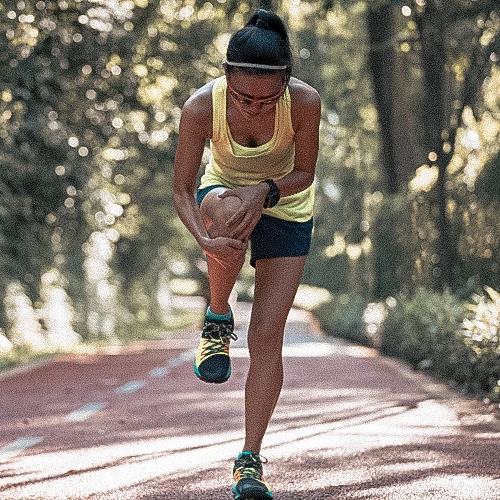
Softening and breakdown of cartilage on the underside of the kneecap causing anterior knee pain.
If you have been told you have chondromalacia patella, you are not alone. This condition — characterized by the softening and deterioration of the cartilage on the underside of the kneecap — is one of the most common sources of anterior knee pain, particularly among active young adults, runners, and women. The good news is that physiotherapy is highly effective at managing symptoms, restoring function, and slowing progression. In this comprehensive guide, we explain exactly what chondromalacia patella is, what causes it, and how evidence-based physiotherapy can help you recover.
Chondromalacia patella (CMP) refers to the pathological softening, fraying, and eventual breakdown of the hyaline cartilage that lines the undersurface of the patella (kneecap). The term comes from the Greek words chondros (cartilage) and malakia (softening). It is sometimes used interchangeably with patellofemoral pain syndrome (PFPS), though technically CMP describes a specific structural change in the cartilage that can be confirmed on imaging or arthroscopy, while PFPS is a broader clinical diagnosis based on symptoms.
Chondromalacia patella is classified using the Outerbridge grading system, which describes four stages of cartilage damage:
Prevalence and demographics: Chondromalacia patella is especially common in adolescents and young adults, with women affected more frequently than men, partly due to wider pelvis anatomy creating a larger Q-angle at the knee. Runners, cyclists, and individuals who perform repetitive squatting or stair-climbing movements are at elevated risk. According to the StatPearls clinical reference, patellofemoral pain accounts for up to 25 percent of all knee complaints presenting to sports medicine clinics.
Common symptoms include:
Understanding the anatomy of the patellofemoral joint helps explain why chondromalacia develops and how physiotherapy targets the underlying mechanics.
The patella (kneecap) is the largest sesamoid bone in the body. It sits within the tendon of the quadriceps muscle group and glides along a groove on the front of the femur called the trochlear groove (or femoral sulcus). This groove acts as a track, guiding the patella smoothly during knee flexion and extension. The undersurface of the patella is coated with articular (hyaline) cartilage — the thickest cartilage in the entire body, measuring up to 6–7 mm — which absorbs compressive forces and reduces friction as the kneecap moves.
The quadriceps muscle group is the primary dynamic stabilizer of the patella. It consists of four muscles: the rectus femoris, vastus lateralis, vastus intermedius, and the critically important vastus medialis oblique (VMO). The VMO is the innermost portion of the quadriceps and provides a medial pull on the patella, counterbalancing the natural lateral pull of the larger vastus lateralis. When the VMO is weak or its activation is delayed, the patella tends to track laterally, increasing pressure on the outer facet of the cartilage.
Additional structures that influence patellar tracking include:
When any of these structures is out of balance — whether through weakness, tightness, or structural variation — the patella no longer tracks centrally in the trochlear groove. The resulting maltracking concentrates force on specific areas of the cartilage, initiating the softening and breakdown characteristic of chondromalacia.
Chondromalacia patella rarely has a single cause. Instead, it typically develops from a combination of biomechanical, anatomical, and activity-related factors:
Patellar malalignment and maltracking
The most common contributing factor is abnormal patellar tracking. When the kneecap does not glide centrally in the trochlear groove, certain areas of cartilage bear disproportionate load. A Q-angle greater than 20 degrees, a shallow trochlear groove, patella alta (high-riding kneecap), or lateral patellar tilt all predispose individuals to maltracking. Research published in the Journal of Orthopaedic Surgery and Research (2023) confirmed that patients with chondromalacia patella demonstrate significantly decreased lateral patellar tilt angles and higher sulcus angles compared to healthy controls, underscoring the role of joint morphology.
Muscle imbalance
Weakness or delayed activation of the VMO relative to the vastus lateralis is one of the most well-documented risk factors. Similarly, weakness of the hip abductors and external rotators (particularly the gluteus medius) allows excessive femoral internal rotation and dynamic knee valgus during activities like running and stair descent. A landmark multicenter randomized controlled trial by Khayambashi et al. (2014) in the Journal of Athletic Training demonstrated that strengthening hip and core muscles produced earlier pain resolution and greater overall strength gains compared to knee-focused protocols alone.
Overuse and repetitive loading
Activities that involve repetitive knee flexion under load — running, cycling, stair climbing, squatting — generate cumulative stress on the patellofemoral cartilage. Patellofemoral joint reaction forces can reach 3–4 times body weight during stair climbing and 7–8 times body weight during deep squatting. Without adequate recovery or muscular support, this repeated loading accelerates cartilage wear.
Trauma
Direct impact to the kneecap (such as a fall onto the knee or a dashboard injury in a motor vehicle accident) can cause acute cartilage damage. Post-surgical immobilization following knee injury can also contribute, as prolonged unloading leads to reduced cartilage proteoglycan synthesis and subsequent softening.
Other risk factors include:
Physiotherapy is universally recommended as the first-line treatment for chondromalacia patella, and clinical evidence consistently supports its effectiveness. The StatPearls clinical reference advises at least one year of conservative management — centered on physiotherapy — before considering surgical options.
The evidence for exercise therapy: A 2025 systematic review with meta-analysis published in BMC Musculoskeletal Disorders, analyzing 12 randomized controlled trials with up to 719 patients, found that strengthening exercises produced statistically significant pain reductions compared to other conservative treatments. At 4–6 weeks, patients in exercise groups experienced an average pain reduction of 1.44 points on visual analogue scales, with women demonstrating particularly strong responses (mean reduction of 2.81 points).
VMO and quadriceps strengthening: Closed-chain quadriceps exercises targeting the VMO are a cornerstone of CMP rehabilitation. By restoring the balance between the VMO and vastus lateralis, these exercises improve patellar tracking and distribute compressive forces more evenly across the cartilage surface.
Hip strengthening: A prospective cohort study published in BMC Musculoskeletal Disorders (2020) followed 65 patients with patellofemoral pain through a simple home-based hip strengthening program (gluteus medius exercises including clamshells, side-lying leg raises, and standing hip abduction with resistance bands). At 12 months, 78 percent of patients achieved clinically meaningful functional improvement, with pain at rest decreasing from 3 to 0 on a numeric rating scale and activity pain dropping from 7 to 3.
Combined manual therapy and exercise: A 2025 randomized controlled trial evaluating 40 patients with chondromalacia patella found that combining manipulative therapy (targeting the thoracolumbar, lumbopelvic, and sacroiliac joints) with strengthening and stretching exercises produced significantly greater improvements in disability, jump performance, and balance compared to exercise alone.
Patellar taping: Research has demonstrated that patellar taping — particularly McConnell taping — provides immediate pain relief by altering patellar position and unloading painful structures. A systematic review in Sports Medicine found that taping combined with exercise produces superior pain reduction compared to exercise alone, supporting its use as an adjunct during rehabilitation.
The prognosis for chondromalacia patella is generally favorable with appropriate physiotherapy management, though recovery timelines vary depending on the grade of cartilage damage, the patient’s activity level, and compliance with rehabilitation.
General timeline:
Key prognostic factors:
A comprehensive physiotherapy program for chondromalacia patella addresses the multiple factors contributing to abnormal patellar loading. At Vaughan Physiotherapy, our approach includes:
Thorough Assessment
Every treatment plan begins with a detailed assessment of your knee mechanics, patellar tracking, muscle strength, flexibility, and lower limb alignment. We evaluate your gait, single-leg squat mechanics, hip strength, and foot posture to identify the specific factors driving your symptoms.
VMO and Quadriceps Strengthening
The VMO is the primary target in CMP rehabilitation. Evidence-based exercises include:
Hip and Core Strengthening
Addressing proximal weakness is essential for controlling dynamic knee valgus:
Patellar Mobilization
Manual mobilization of the patella — including medial glides, superior and inferior glides, and patellar tilts — helps restore normal patellar mobility and reduce pain. These techniques are particularly useful when the lateral retinaculum is tight, restricting medial patellar movement.
Taping and Bracing
Stretching and Flexibility
Tightness in the structures surrounding the knee increases patellofemoral compression:
Activity Modification and Load Management
During the acute phase, we help you modify activities that aggravate symptoms while maintaining overall fitness:
Manual Therapy
As demonstrated by recent clinical trials, joint mobilization techniques targeting the lumbopelvic region and lower extremity can enhance outcomes when combined with exercise. Soft tissue release of the lateral retinaculum, ITB, and quadriceps may also be incorporated.
Is chondromalacia patella the same as runner’s knee?
The terms are often used interchangeably in casual conversation, but they are not identical. “Runner’s knee” is a general term that can refer to several conditions causing anterior knee pain, including chondromalacia patella and iliotibial band syndrome. Chondromalacia patella specifically refers to structural softening of the cartilage on the underside of the kneecap, which can be confirmed on MRI or arthroscopy.
Can chondromalacia patella heal on its own?
Grade I chondromalacia (cartilage softening without surface damage) may improve with activity modification and appropriate loading, as cartilage can respond positively to controlled mechanical stress. However, more advanced grades (II–IV) involve structural cartilage damage that does not regenerate on its own. This is why physiotherapy is so important: while cartilage itself has limited healing capacity, strengthening the surrounding muscles, correcting patellar tracking, and optimizing load distribution can significantly reduce pain and prevent further deterioration.
Will I need surgery for chondromalacia patella?
The vast majority of patients with chondromalacia patella respond well to conservative management including physiotherapy, and surgery is rarely necessary. Clinical guidelines recommend at least 12 months of structured physiotherapy before considering surgical options. If conservative management fails, surgical options may include arthroscopic debridement, lateral retinacular release, or patellar realignment procedures.
Can I still exercise with chondromalacia patella?
Yes, and in fact, appropriate exercise is essential for recovery. The key is to modify your activities to avoid excessive patellofemoral loading while maintaining strength and fitness. Low-impact activities such as swimming, stationary cycling (with proper seat height), and aquatic exercise are generally well-tolerated.
How long does physiotherapy take to work for chondromalacia patella?
Most patients experience meaningful pain relief within the first 4–6 weeks of a structured physiotherapy program, with significant functional improvement by 8–12 weeks. Full recovery and return to all activities typically takes 3–6 months, though this varies depending on the severity of cartilage damage and individual factors.
Does chondromalacia patella lead to arthritis?
Untreated chondromalacia can progress to patellofemoral osteoarthritis over time, particularly in cases of advanced cartilage loss (Grade III–IV). This is one of the strongest arguments for early physiotherapy intervention. By addressing the underlying biomechanical causes, you can slow or halt the progression of cartilage damage.
Is it safe to squat with chondromalacia patella?
Squatting is not inherently harmful, but the depth and load need to be managed carefully. Shallow squats (0–40 degrees of knee flexion) are generally well-tolerated and are actually a cornerstone of VMO strengthening. Deep squats beyond 90 degrees generate very high patellofemoral compression forces and may need to be limited during early rehabilitation.
Do any of these sound familiar?
Our evidence-based three-phase rehabilitation approach:
Vaughan Physiotherapy has helped thousands of patients overcome anterior knee pain and return to the activities they love. Our experienced physiotherapists use the latest evidence-based techniques to create personalized treatment plans that address the root cause of your chondromalacia patella.
Phone: 905-669-1221
Location: 398 Steeles Ave W, Unit 201, Thornhill, ON L4J 6X3
Website: www.vaughanphysiotherapy.com
Proudly serving Thornhill, Langstaff, Willowdale, North York, Markham, Richmond Hill, Concord, and North Toronto.
Recover faster, move better, and feel stronger with expert physiotherapy. Our team is here to guide you every step of the way.

Explore the latest articles written by our clinicians