Cuboid Syndrome

Subluxation or irritation of the cuboid bone causing lateral foot pain, often following ankle sprains.

What Is Cuboid Syndrome? Understanding the Condition

Cuboid syndrome is a frequently underdiagnosed source of lateral midfoot pain that involves a minor disruption or subluxation of the structural congruity of the calcaneocuboid joint. The condition, also referred to as a "subluxed cuboid," "locked cuboid," or "dropped cuboid," irritates the surrounding joint capsule, ligaments, and the peroneus longus tendon as it courses beneath the bone. Because the displacement is subtle and often does not appear on standard imaging, cuboid syndrome can persist for weeks or months before being correctly identified.

The hallmark symptom is diffuse or focal pain along the lateral border of the foot, typically localized over the cuboid bone itself. This pain frequently intensifies during weight-bearing activities such as walking, running, or pushing off during the toe-off phase of gait. In some cases, the discomfort radiates into the plantar arch or along the fourth metatarsal. Patients often describe a vague ache that worsens with activity and eases with rest, alongside a feeling of weakness or instability in the foot during propulsion.

Common Symptoms

  • Lateral midfoot pain that worsens with weight-bearing, walking, or running
  • Point tenderness directly over the cuboid bone on the outer foot
  • Pain during the push-off (toe-off) phase of gait
  • Possible swelling, redness, or mild ecchymosis over the lateral midfoot
  • Decreased active and passive range of motion in the foot and ankle
  • Sensation of foot weakness or "giving way" during dynamic activities
  • Pain with passive inversion of the foot and resistive eversion or plantarflexion
  • An antalgic gait pattern, often shifting weight to the medial foot

Prevalence

Although precise epidemiological data remain limited, the available evidence highlights that cuboid syndrome is more common than many clinicians realize. Research indicates that approximately 4% of all athletes presenting with foot injuries are diagnosed with cuboid syndrome. Among patients who sustain a plantar flexion and inversion-type ankle sprain, the incidence rises to approximately 6.7%. The condition is particularly prevalent in dancers: studies have found that cuboid syndrome accounts for up to 17% of foot and ankle injuries in professional ballet dancers. Additionally, up to 40% of patients with lateral ankle sprains may develop residual midfoot symptoms that could be attributable to cuboid involvement, suggesting the condition is frequently overlooked in the aftermath of common ankle injuries.

Anatomy of the Cuboid and the Lateral Foot

A thorough understanding of the anatomy surrounding the cuboid bone is essential for appreciating why this structure is so vulnerable to dysfunction and why targeted manual therapy can be remarkably effective in resolving it.

The Cuboid Bone

The cuboid is one of seven tarsal bones in the foot, positioned laterally in the distal row of the tarsus. It is aptly named for its roughly cube-like shape and features a distinctive plantar prominence called the tuberosity, along with a groove on its plantar surface through which the peroneus longus tendon passes. The cuboid occupies a unique and biomechanically critical position: it serves as the keystone of the lateral column of the foot, providing structural stability during both static standing and dynamic locomotion.

The cuboid has five articular surfaces and connects to multiple surrounding bones:

  • Posteriorly: It articulates with the calcaneus (heel bone) at the calcaneocuboid joint, which is part of the larger midtarsal (Chopart's) joint complex.
  • Anteriorly: It articulates with the bases of the fourth and fifth metatarsals at the tarsometatarsal (Lisfranc) joint complex.
  • Medially: It articulates with the lateral cuneiform and, in many individuals, with the navicular bone.

This central position means the cuboid participates in both the midtarsal joint (which governs rearfoot-to-forefoot motion) and the tarsometatarsal joint (which governs forefoot rigidity during push-off). Any disruption to the cuboid's alignment affects the locking mechanism of the entire lateral column.

The Calcaneocuboid Joint

The calcaneocuboid (CC) joint is the primary articulation involved in cuboid syndrome. This saddle-shaped joint permits medial and lateral rotation of the cuboid about an anterior-posterior axis, with the cuboid capable of rotating up to 25 degrees during combined inversion and eversion movements. The CC joint plays a critical role in the midtarsal locking mechanism: when the subtalar joint supinates during the push-off phase of gait, the CC joint axes converge, creating a rigid lever arm for efficient propulsion. If the cuboid is subluxed or hypomobile, this locking mechanism fails, leading to a loss of lateral column stability and compensatory dysfunction up the kinetic chain.

Multiple ligaments reinforce the CC joint, including the dorsal calcaneocuboid ligament, the plantar calcaneocuboid (short plantar) ligament, and the long plantar ligament. These structures resist excessive motion but can be compromised during forceful inversion ankle sprains, leaving the cuboid vulnerable to displacement.

Cadaveric studies have also identified that fibroadipose synovial folds occupy approximately 35% of the CC joint space. These folds may contribute to joint restriction or impingement when the cuboid is displaced, potentially explaining the mechanical "locking" sensation many patients describe.

The Peroneus Longus Tendon

The peroneus longus muscle, which originates from the upper lateral fibula, sends its tendon along the lateral ankle, around the lateral malleolus, and then beneath the cuboid bone through a dedicated groove on the cuboid's plantar surface. This groove effectively turns the cuboid into a pulley for the peroneus longus tendon. The tendon then crosses the sole of the foot diagonally to insert on the base of the first metatarsal and the medial cuneiform.

During the midstance-to-propulsion phases of gait, the peroneus longus contracts forcefully to stabilize the first ray and evert the forefoot. This contraction exerts an eversion torque on the cuboid, pulling its plantar surface laterally. When the calcaneocuboid joint is already destabilized (for example, after an ankle sprain has stretched the supporting ligaments), this repetitive eversion force can gradually displace the cuboid into a plantarward or internally rotated position, initiating or perpetuating the syndrome.

Blood Supply

The cuboid receives its blood supply primarily from the lateral plantar artery, a branch of the posterior tibial artery. An anastomosis between the lateral and medial plantar arteries provides adequate circulation to support bone health and healing following injury.

Start Your Journey to 

Better Health Today

Recover faster, move better, and feel stronger with expert physiotherapy. Our team is here to guide you every step of the way.

How Does Cuboid Syndrome Develop? Causes and Risk Factors

Cuboid syndrome arises from a disruption of the normal arthrokinematics or structural congruity of the calcaneocuboid joint. Although the precise pathomechanic mechanism has not been fully elucidated, clinical evidence and biomechanical reasoning point to several well-established causes and predisposing factors.

Primary Causes

  • Lateral Ankle Sprains (Inversion Injuries): The most common cause of cuboid syndrome is a plantar flexion and inversion ankle sprain. During this mechanism, the calcaneocuboid ligaments can be stretched or partially torn, and the forceful eversion of the cuboid against an inverted calcaneus disrupts joint congruency. Approximately 6.7% of patients with inversion ankle sprains develop concurrent cuboid syndrome, though the true incidence may be higher because the condition is frequently masked by the more obvious ankle sprain symptoms.
  • Overuse and Repetitive Microtrauma: In athletes and dancers, cuboid syndrome can develop without a single traumatic event. Repetitive loading during running, jumping, or dancing subjects the calcaneocuboid joint to cumulative stress. Professional ballet dancers are particularly susceptible because of the extreme plantarflexion demands of working en pointe and demi-pointe.
  • Peroneus Longus Traction: During propulsion, the peroneus longus muscle exerts a powerful eversion moment on the cuboid. When the supporting ligaments are weakened or when the foot is excessively pronated, this repetitive traction force can gradually displace the cuboid into a plantarward or internally rotated position.

Risk Factors

  • Excessive Foot Pronation: A pronated foot structure was found in approximately 80% of patients in some clinical populations with cuboid syndrome. Overpronation destabilizes the midtarsal joint, reduces the congruency of the calcaneocuboid articulation, and increases the mechanical advantage of the peroneus longus to displace the cuboid.
  • Dance and Ballet: Up to 17% of foot and ankle injuries in professional ballet dancers involve cuboid syndrome.
  • Running on Uneven Terrain: Training on cambered roads, uneven trails, or surfaces that challenge lateral stability increases the mechanical stress on the lateral column of the foot.
  • Inadequate Footwear: Faulty shoe construction, worn-out running shoes, or shoes that fail to provide adequate lateral column support can contribute to midtarsal instability.
  • Improperly Constructed Orthotics: Poorly fitted orthoses can paradoxically increase lateral foot stress.
  • Pes Cavus with Anterior Equinus: A high-arched foot with forefoot equinus places increased load on the lateral column during weight-bearing.
  • Inadequate Recovery Between Training Sessions: Insufficient rest periods reduce the body's ability to repair microtrauma at the calcaneocuboid joint.

Why Physiotherapy Is Critical for Cuboid Syndrome Recovery

Physiotherapy is the cornerstone of cuboid syndrome management because the condition responds exceptionally well to skilled manual intervention and targeted rehabilitation. Unlike many musculoskeletal conditions that require prolonged conservative care or surgical consultation, cuboid syndrome can often be resolved rapidly when the correct diagnosis is made and appropriate treatment is applied.

The Power of Cuboid Manipulation

The single most important intervention for cuboid syndrome is joint manipulation, specifically the cuboid whip or cuboid squeeze technique. Research consistently demonstrates remarkable outcomes:

  • In a landmark case series by Jennings and Davies examining 104 patients with ankle sprains, seven had concurrent cuboid syndrome. Following manipulation using the cuboid whip technique, all seven patients reported substantial resolution of symptoms and returned to sport within 24 hours. At follow-up (2 to 8 months), zero patients experienced symptom recurrence.
  • Marshall and Hamilton treated three professional ballet dancers with cuboid syndrome. One showed immediate and complete cessation of symptoms after a single manipulation. At a five-year follow-up, none experienced recurrence.

These outcomes underscore that once properly diagnosed, cuboid syndrome has an excellent prognosis with conservative physiotherapy management.

Why Manual Therapy Alone Is Not Enough

While manipulation is the catalyst for recovery, it must be supported by a comprehensive rehabilitation program to address the underlying biomechanical factors. Without addressing excessive pronation, peroneal muscle imbalances, proprioceptive deficits, and lateral column instability, the cuboid is likely to sublux again during high-demand activities.

Symptom Duration Matters

  • One-week symptom duration: Typically requires only 1 to 2 manipulation sessions
  • One-month symptom duration: May require 3 to 4 manipulation sessions
  • Six-month symptom duration: May require up to six months of treatment, though patients often report approximately 50% immediate improvement after the first manipulation

What to Expect: Prognosis and Recovery Timeline

The prognosis for cuboid syndrome is excellent when the condition is accurately diagnosed and treated with appropriate physiotherapy. The vast majority of patients achieve full resolution of symptoms through conservative care alone.

Recovery Timeline

  • Acute Cases (Less Than One Week): 1 to 2 manipulation sessions. Return to activity within 24 to 48 hours.
  • Subacute Cases (2 to 4 Weeks): 3 to 4 sessions over 2 to 3 weeks. Return to full activity within 3 to 4 weeks.
  • Chronic Cases (Beyond 6 Weeks): Extended treatment spanning several weeks to months. Approximately 50% improvement after initial manipulation.

Indicators of Improvement

  • Improved tolerance to heel raises without lateral foot pain
  • Reduced discomfort during passive dorsal-plantar cuboid glide testing
  • Normalized gait pattern without antalgic compensation
  • Pain-free weight-bearing during single-leg stance and push-off activities

Physiotherapy Treatment Approaches

Comprehensive Assessment

A thorough clinical assessment is critical because cuboid syndrome cannot be reliably diagnosed through imaging alone. Standard X-rays, CT scans, and MRI are of "little value" in diagnosing cuboid syndrome because the subluxation is minor and the cuboid often self-reduces before imaging occurs. Diagnosis depends on a constellation of clinical signs, symptoms, and a high index of suspicion.

Cuboid Manipulation: The Primary Intervention

Unless contraindicated (bone disease, inflammatory arthritis, gout, neural or vascular compromise, or fracture), manipulation of the cuboid should be considered as the initial treatment. Two primary techniques are used:

  • The Cuboid Whip: The patient lies prone with the knee flexed to 70 to 90 degrees. The clinician cups the dorsum of the forefoot, placing both thumbs on the plantomedial aspect of the cuboid. With the ankle positioned at neutral dorsiflexion and the patient's leg relaxed, the clinician abruptly extends the knee while plantarflexing the ankle and subtly supinating the subtalar joint. Simultaneously, a low-amplitude, high-velocity thrust is directed through the thumbs to mobilize the cuboid dorsally. An audible "pop" may occur but is not essential for a successful result.
  • The Cuboid Squeeze: The clinician gradually stretches the ankle into maximal plantarflexion with the foot and toes maximally flexed. Once the soft tissues have relaxed, the clinician uses the thumbs to squeeze the cuboid dorsally from its plantar surface. This technique offers better directional control than the whip and is often preferred for overuse-related presentations.

Post-Manipulation Management

  • Cryotherapy to manage post-manipulation discomfort and reduce inflammation
  • Low-intensity pulsed ultrasound to support collagen synthesis
  • Avoid vigorous weight-bearing for several days while the joint stabilizes
  • Gentle massage to normalize surrounding muscle tone

Cuboid Taping and Padding

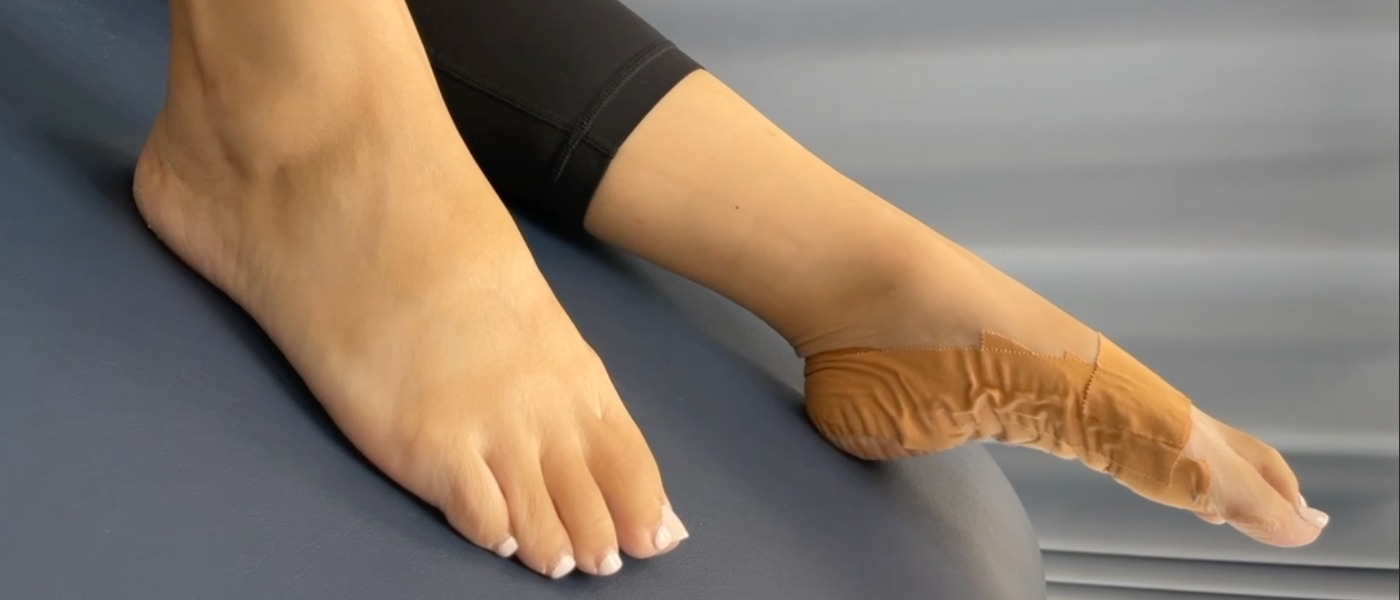
  • Low-dye arch taping with a cuboid pad (1/8 or 1/4 inch felt padding under the medial cuboid) prevents eversion during weight-bearing
  • Lateral calcaneal wedges reduce weight-bearing pain and support the lateral column
  • Taping during initial weeks and return to sport

Strengthening and Exercise Rehabilitation

  • Peroneus longus and triceps surae stretching: Reduce traction forces on the cuboid
  • Intrinsic foot muscle strengthening: Towel curls, marble pickups, short-foot exercises for midfoot stability
  • Extrinsic foot and ankle strengthening: Resisted eversion, inversion, dorsiflexion, and plantarflexion with bands
  • Progressive heel raise training: Single-leg heel raises to challenge the lateral column functionally

Proprioception and Balance Training

  • Single-leg balance on stable and unstable surfaces
  • Dynamic balance challenges incorporating reaching, catching, or perturbation training
  • Sport-specific agility and cutting drills as rehabilitation progresses

Orthotic Recommendations

  • Custom or semi-custom orthotics to reduce excessive pronation
  • Cuboid padding incorporated into the orthotic
  • Footwear assessment to ensure adequate lateral column support

Preventing Cuboid Syndrome Recurrence

  • Maintain ankle and foot strength: Ongoing strengthening 2 to 3 sessions per week for at-risk athletes and dancers
  • Address excessive pronation: Continued use of supportive orthotics and appropriate footwear
  • Preserve proprioceptive function: 5 to 10 minutes of single-leg balance work during warm-ups
  • Manage training surfaces and volume: Vary surfaces, avoid excessive cambered road running, and progress gradually
  • Monitor footwear condition: Replace running shoes every 400 to 800 kilometers
  • Early intervention for ankle sprains: Thorough rehabilitation including midfoot mechanics assessment to catch cuboid involvement early

FAQs

  • What does cuboid syndrome feel like?
    • Cuboid syndrome typically presents as a diffuse, aching pain along the outer border of the foot, centered over the cuboid bone. The pain worsens with weight-bearing activities and improves with rest. Some patients describe a sensation of foot weakness or instability during dynamic activities.
  • Can cuboid syndrome be seen on X-ray or MRI?
    • Standard imaging is generally of limited value. Because the subluxation is minor and the cuboid often returns to near-normal alignment before imaging occurs, X-rays and MRI typically appear normal. Diagnosis relies on clinical examination and a thorough patient history.
  • How long does cuboid syndrome last without treatment?
    • Without appropriate treatment, cuboid syndrome can persist for weeks, months, or longer. The calcaneocuboid joint dysfunction does not tend to resolve spontaneously in active individuals. Early treatment leads to significantly faster recovery.
  • Is the cuboid whip manipulation painful?
    • Most patients experience only brief, mild discomfort during the manipulation. Many feel immediate relief of their lateral foot pain afterward. Any mild soreness typically resolves within 24 to 48 hours with ice application.
  • Can cuboid syndrome come back after treatment?
    • Recurrence is possible if underlying biomechanical factors are not addressed. However, case series with follow-up periods of up to five years report zero recurrence rates when manipulation is combined with appropriate exercise rehabilitation, taping, and orthotic support.
  • Is cuboid syndrome the same as a cuboid fracture?
    • No. Cuboid syndrome involves subtle displacement of the calcaneocuboid joint without a break in the bone. A cuboid fracture involves an actual break and typically requires immobilization or surgical intervention. Your physiotherapist can differentiate between the two during assessment.

Take the First Step Toward Recovery

Don't let lateral foot pain from cuboid syndrome slow you down or sideline you from the activities you love. Our experienced physiotherapy team specializes in the assessment and treatment of midfoot conditions, including expert cuboid manipulation techniques that can provide rapid relief.

Book Your Assessment Today

Phone: 905-669-1221

Location: 398 Steeles Ave W #201, Thornhill, ON L4J 6X3

Online Booking: www.vaughanphysiotherapy.com

Serving communities across Thornhill, Langstaff, Newtonbrook, Willowdale, North York, Markham, Richmond Hill, Concord, and North Toronto.

Conveniently located in the heart of Thornhill, offering flexible scheduling to accommodate your recovery needs.

Get Better Today

Whether you are dealing with lingering lateral foot pain after an ankle sprain, persistent discomfort during running or dance, or a frustrating diagnosis that seems to have been missed, our team is here to help. Cuboid syndrome is highly treatable, and with the right physiotherapy approach, most patients experience significant improvement from the very first session. Take the first step and let us help you get back to moving with confidence.

Team

Expert Insights

Explore the latest articles written by our clinicians