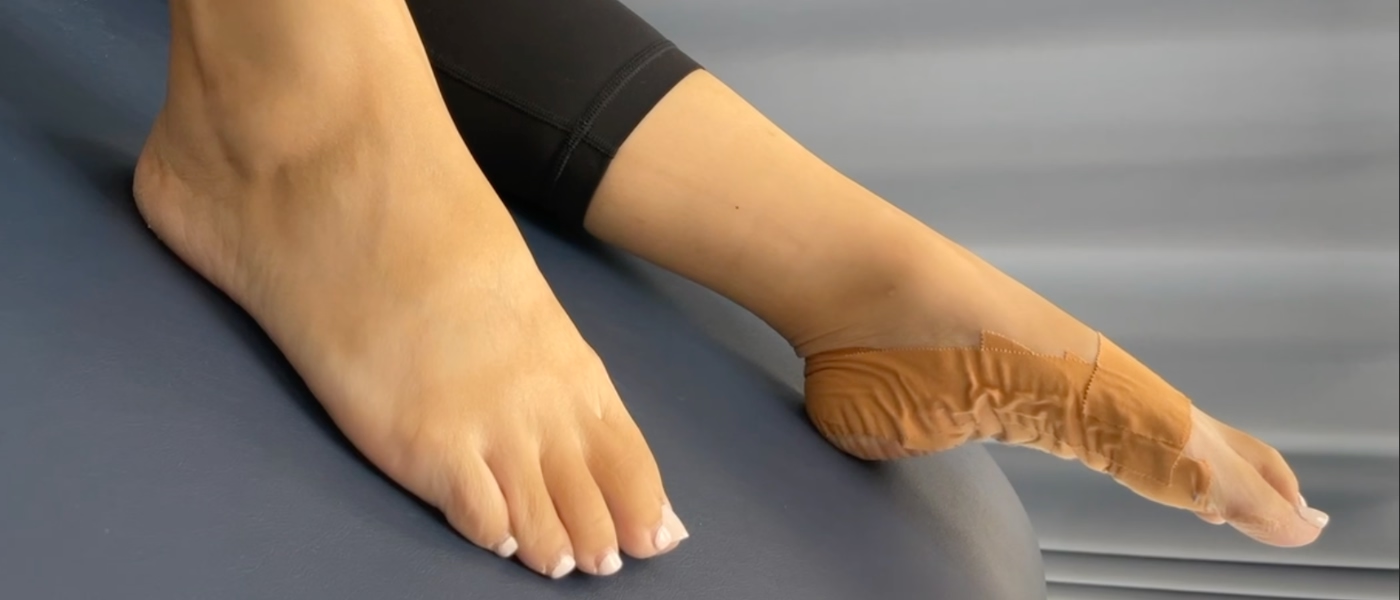
Progressive deformity of the big toe joint causing pain, swelling, and difficulty with footwear.
Bunions are one of the most common foot conditions affecting adults, yet many people delay seeking treatment until the deformity becomes severe. Hallux valgus -- the clinical term for a bunion -- is a progressive condition that responds well to early, evidence-based physiotherapy intervention. This guide explores the anatomy, causes, treatment approaches, and long-term management strategies that can help you take control of your bunion pain and maintain an active lifestyle.
Hallux valgus is a structural deformity of the foot characterized by the lateral deviation of the great toe (hallux) toward the second toe, combined with a medial shift of the first metatarsal bone. This misalignment creates the visible bony prominence on the inner side of the foot known as a bunion. The condition is not simply a "bump" -- it reflects a complex, triplanar deformity involving changes in bone position, joint alignment, and soft tissue balance across the transverse, sagittal, and coronal planes of the foot.
Key symptoms of hallux valgus include:
Prevalence data confirms this is a widespread concern: hallux valgus affects approximately 23% of adults aged 18-65 and rises to 36% in those over 65, according to large epidemiological studies (Nix et al., 2010). Women are disproportionately affected, with some studies reporting female-to-male ratios as high as 15:1.
Clinical grading is based on weight-bearing radiographic measurements of two key angles:
Understanding the severity of your bunion is essential for determining the most appropriate treatment pathway, and this is where a thorough clinical assessment becomes invaluable.
To understand why bunions develop and how physiotherapy can help, it is important to appreciate the anatomy of the first metatarsophalangeal (MTP) joint -- the joint at the base of your big toe.
The first MTP joint is formed by the articulation between the head of the first metatarsal bone and the base of the proximal phalanx of the great toe. This joint is critical for normal gait, bearing up to 60% of body weight during the push-off phase of walking. Beneath the metatarsal head sit two small, pea-shaped bones called sesamoids, which are embedded within the tendons of the flexor hallucis brevis muscle. These sesamoids serve as a pulley system, increasing the mechanical advantage of the toe flexors and protecting the joint during weight-bearing activities.
The stability of the first MTP joint depends on a delicate balance between static stabilizers (ligaments, joint capsule, and plantar plate) and dynamic stabilizers (the surrounding musculature). Key structures include:
In hallux valgus, the balance between the abductor and adductor hallucis muscles becomes disrupted. As the first metatarsal drifts medially, the abductor hallucis rotates beneath the metatarsal head and loses its mechanical ability to correct the deviation. Simultaneously, the adductor hallucis and lateral capsule exert an unopposed lateral pull, further accentuating the deformity. The sesamoid apparatus subluxes laterally, disrupting normal flexor function and creating a self-perpetuating cycle of progressive misalignment. This understanding of muscle imbalance is precisely why targeted physiotherapy -- aimed at restoring the strength and function of key stabilizing muscles -- is so fundamental to bunion management.
Hallux valgus is a multifactorial condition, meaning no single cause is responsible. Rather, a combination of intrinsic (genetic and structural) and extrinsic (environmental) factors contributes to its development and progression.
Research consistently identifies genetic predisposition as the strongest risk factor. Familial clustering of hallux valgus is well-documented, with first-degree relatives of affected individuals demonstrating significantly higher rates of the condition. Specific inherited traits that increase susceptibility include first ray hypermobility, metatarsal head shape (a rounded metatarsal head is more prone to deviation), ligamentous laxity, and abnormal foot architecture. Connective tissue disorders such as Marfan syndrome and Ehlers-Danlos syndrome, as well as Down syndrome, are associated with higher rates of hallux valgus due to collagen abnormalities and ligamentous imbalances.
While narrow, pointed-toe shoes and high heels have traditionally been blamed as the primary cause of bunions, contemporary evidence suggests that ill-fitting footwear is more of an aggravating factor than a causative one (Perera et al., 2011). That said, restrictive shoes with narrow toe boxes compress the forefoot, increase pressure on the first MTP joint, and can accelerate the progression of an existing deformity. Populations that habitually wear shoes demonstrate higher hallux valgus prevalence than barefoot populations, supporting footwear's role as a contributing factor.
Several biomechanical abnormalities increase hallux valgus risk:
Hallux valgus prevalence increases with age, reflecting cumulative mechanical stress and progressive soft tissue degradation. Women are significantly more affected -- likely due to a combination of hormonal influences on ligament laxity, anatomical differences in foot structure, and historically greater exposure to constrictive footwear.
Rheumatoid arthritis, psoriatic arthritis, and gouty arthritis can all accelerate hallux valgus through inflammatory destruction of joint structures. Neuromuscular conditions including cerebral palsy, stroke sequelae, and peripheral neuropathy may also contribute through altered muscle tone and motor control.
The question of whether to pursue conservative or surgical management is central to hallux valgus treatment. Current evidence and clinical guidelines, including the 2024 NICE guidelines update (Ahmad et al., 2024), position conservative management -- including physiotherapy -- as the first-line approach for hallux valgus, with surgery reserved for cases that fail to respond.
A 2021 systematic review and network meta-analysis published in the International Journal of Environmental Research and Public Health evaluated multiple conservative interventions and concluded that a combination of exercise therapy and toe separators demonstrated the highest probability of being the most effective intervention for reducing the hallux valgus angle. The analysis further noted that conservative treatment for hallux valgus "requires a combination of patient-active exercise and physiotherapist-led passive therapy" for optimal outcomes.
A 2025 randomized controlled trial published in Frontiers in Physiology (involving 82 women with hallux valgus) found that exercise-based therapy significantly reduced pain across all treatment groups and improved hallux positioning. Notably, the study found that exercise alone was as effective as exercise combined with taping or orthotic devices for structural correction, underscoring the central importance of therapeutic exercise.
While it is important to note that conservative measures do not reverse established bony deformity, physiotherapy has been shown to:
According to current guidelines, surgical referral is appropriate when:
Even when surgery is indicated, pre-operative physiotherapy improves post-surgical outcomes, and post-operative rehabilitation is critical for restoring weight-bearing capacity and first ray function.
Understanding realistic timelines helps set appropriate expectations for your hallux valgus management journey.
Several factors influence how well you respond to conservative treatment:
For patients who require surgery, bone healing takes approximately 6-7 weeks, with return to work at 6-12 weeks postoperatively. Full recovery and return to sport typically requires 3-6 months. Recurrence rates following surgery range from 10% to 47% depending on the procedure performed, patient factors, and post-operative management -- highlighting the importance of ongoing physiotherapy even after surgical correction.
Recover faster, move better, and feel stronger with expert physiotherapy. Our team is here to guide you every step of the way.

Evidence-based physiotherapy for hallux valgus employs a multifaceted approach targeting the underlying biomechanical dysfunction, pain, and functional limitations.
Every effective treatment plan begins with a thorough biomechanical assessment of the foot and lower limb. Your physiotherapist will evaluate:
This comprehensive evaluation ensures that treatment targets the specific biomechanical drivers of your individual presentation.
Targeted strengthening of the intrinsic foot muscles is the cornerstone of physiotherapy for hallux valgus. Research confirms that muscular imbalances between the adductor and abductor hallucis muscles contribute directly to deformity progression, and that targeted strengthening effectively addresses these asymmetries.
Key exercises include:
Manual therapy techniques applied to the first MTP joint and surrounding structures help maintain and improve joint mobility. Physiotherapy mobilization techniques include:
A 2021 network meta-analysis found that manipulation combined with ice therapy demonstrated the highest probability of being the best intervention for improving Foot Function Index scores in hallux valgus patients.
Maintaining flexibility in the muscles and soft tissues surrounding the first MTP joint is essential for preventing further contracture and maintaining functional range of motion:
While orthotics alone have shown mixed results for structural correction, they play a valuable role as part of a comprehensive management strategy:
Strategic modifications to daily activities can significantly reduce symptoms and slow progression:
Prevention and early intervention are always preferable to managing advanced deformity. Whether you have early signs of hallux valgus or are managing an existing condition, these strategies can help slow or prevent progression:
Can physiotherapy actually correct a bunion?
Physiotherapy cannot reverse an established bony deformity. However, research consistently shows that targeted exercise therapy can reduce pain, improve toe alignment in mild cases, strengthen supporting muscles, and slow or halt progression. A 2025 clinical trial demonstrated that 12 weeks of exercise-based therapy significantly reduced the hallux valgus angle and pain in women with bunions.
How long does it take for physiotherapy to help with bunion pain?
Most patients experience meaningful pain reduction within 2-4 weeks of beginning a consistent physiotherapy program. Maximum therapeutic benefits are typically achieved within 3-6 months of regular treatment and home exercise adherence. Ongoing maintenance exercises are recommended indefinitely.
Do toe spacers and bunion splints actually work?
Evidence from a 2021 systematic review and network meta-analysis found that toe separators combined with exercise had the highest probability of being the most effective conservative intervention for reducing the hallux valgus angle. Night splints also showed benefit. However, these devices work best as part of a comprehensive program including exercise and appropriate footwear, rather than as standalone treatments.
At what point should I consider surgery for my bunion?
Current clinical guidelines recommend surgery only after at least 3 months of conservative management has failed to provide adequate relief. Key indications include persistent pain despite non-surgical treatment, significant functional limitations, progressive deformity, and development of secondary problems such as hammertoes or metatarsalgia. Surgery should never be pursued for cosmetic reasons alone.
Can I still exercise and stay active with a bunion?
Absolutely. In fact, staying active is important for overall foot health. The key is modifying activities to reduce excessive first MTP joint stress. Low-impact options like swimming, cycling, and yoga are generally well-tolerated. Your physiotherapist can help design an exercise program that maintains fitness while protecting your foot. Barefoot training on appropriate surfaces can actually help strengthen the intrinsic foot muscles that support the big toe.
Is hallux valgus hereditary?
Yes, genetic predisposition is the strongest identified risk factor for hallux valgus. If your parents or grandparents had bunions, you have a significantly higher likelihood of developing them. Inherited traits such as foot shape, ligament laxity, and first ray structure all contribute. However, having a genetic predisposition does not guarantee you will develop a problematic bunion -- appropriate footwear, exercises, and early intervention can help manage hereditary risk.
What is the difference between a bunion and hallux rigidus?
While both conditions affect the first MTP joint, they are distinct. Hallux valgus (bunion) involves lateral deviation of the big toe with a medial bony prominence. Hallux rigidus is a degenerative arthritic condition characterized by stiffness and loss of motion at the first MTP joint, typically with dorsal bone spurs. The conditions can coexist but require different treatment approaches.
Our comprehensive treatment programs include:
Don't let bunion pain limit your mobility or affect your daily life. Our experienced team is ready to help you find relief and improve your foot function.
Book Your Specialized Assessment Today:
Serving communities across Thornhill, Langstaff, Newtonbrook, Willowdale, North York, Markham, Richmond Hill, Concord, and North Toronto.
Conveniently located in the heart of Thornhill, offering flexible scheduling to accommodate your recovery needs.
Whether you're battling:
Our 3-phase rehab system helps you:
Phase 1: Reduce pain with manual therapy and protective strategies
Phase 2: Rebuild toe strength and joint mobility through targeted exercises
Phase 3: Optimize footwear and biomechanics for long-term relief
Explore the latest articles written by our clinicians