.avif)
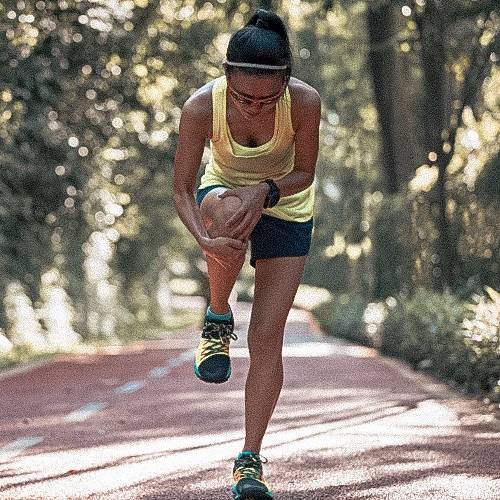
Impingement and inflammation of the infrapatellar fat pad causing anterior knee pain below the kneecap.
Hoffa fat pad syndrome, also known as infrapatellar fat pad impingement or Hoffa's disease, is a condition in which the infrapatellar fat pad at the front of the knee becomes pinched, irritated, and inflamed. The result is a deep, aching or burning pain just below the kneecap that can make everyday activities such as walking, climbing stairs, and straightening the leg surprisingly uncomfortable.
First described by German surgeon Albert Hoffa in 1904, the condition is now recognized as an underdiagnosed source of anterior knee pain. Because its symptoms overlap with patellar tendinopathy, meniscal injuries, and patellofemoral syndrome, many patients go weeks or months without an accurate diagnosis. Research suggests that Hoffa fat pad pathology appears in roughly 1% of all knee arthroscopies, though the true prevalence is likely much higher because most cases respond to conservative treatment and never require surgery (Dragoo et al., 2012; Hannon et al., 2016).
The good news is that physiotherapy is the first-line treatment for Hoffa fat pad syndrome, and the vast majority of patients recover fully without surgical intervention. Understanding the anatomy behind the condition, recognizing the warning signs early, and committing to a structured rehabilitation program are the keys to a complete and lasting recovery.
The infrapatellar fat pad (IFP) is a wedge-shaped mass of adipose tissue that sits inside the knee joint capsule but outside the synovial membrane, making it an intracapsular yet extra-synovial structure. It occupies most of the anterior compartment of the knee, filling the space between the patellar tendon in front, the femoral condyles above, and the tibial plateau below.
The fat pad is organized into distinct lobules of unilocular fat cells (adipocytes) enclosed within a framework of connective tissue. It attaches to the inferior pole of the patella, the patellar tendon, the anterior horns of the medial and lateral menisci, and the periosteum of the anterior tibia. Two wing-like folds of synovial tissue called alar folds extend from its sides, while a central band known as the infrapatellar plica (ligamentum mucosum) connects it to the intercondylar notch of the femur.
The infrapatellar fat pad is one of the most richly vascularized and innervated structures in the knee. It receives its blood supply from the inferior genicular arteries and the anterior tibial recurrent artery. Critically, it is densely packed with nerve endings, including nociceptors (pain receptors) supplied by the posterior articular nerve, a branch of the tibial nerve. This abundant nerve supply explains why even mild inflammation or impingement of the fat pad can produce significant pain.
Although it was once considered a simple space-filler, modern research has revealed that the infrapatellar fat pad serves several important biomechanical and biological roles:
Because the fat pad changes shape with every degree of knee flexion and extension, it is constantly at risk of being pinched between the patella and the femoral condyles, particularly at or near full extension. When trauma, swelling, or anatomical variation reduces the available space, the stage is set for impingement.
Hoffa fat pad syndrome develops when the infrapatellar fat pad is repeatedly or acutely compressed between the patella and the femur, triggering a cycle of inflammation, swelling, and further impingement. The causes can be grouped into traumatic, biomechanical, and iatrogenic categories.
A direct blow to the front of the knee, such as a fall onto a hard surface, a dashboard injury in a motor vehicle collision, or a contact sports impact, can compress the fat pad and cause bleeding and swelling within its tissue. Forced hyperextension of the knee is another common mechanism: when the knee snaps beyond its normal straight position, the fat pad is crushed between the tibia and the femur.
Activities that involve repeated full knee extension under load place cumulative stress on the fat pad. Runners, cyclists, soccer players, volleyball players, and military personnel are at elevated risk. Jumping sports are particularly implicated because of the repetitive eccentric loading of the extensor mechanism during landing.
When the kneecap does not glide smoothly through the trochlear groove, it can shift laterally and compress the superolateral portion of the fat pad. A 2023 systematic review examining 3,603 knees identified three confirmed predisposing anatomical factors (Habet et al., 2023):
These anatomical variants create a biomechanical environment in which the fat pad is more exposed to compression during normal knee motion.
Surgical procedures on the knee can alter the anatomy of the anterior compartment and predispose the fat pad to impingement. Arthroscopy, anterior cruciate ligament (ACL) reconstruction, and total knee arthroplasty may all promote scarring (fibrosis) within or around the fat pad, reducing its mobility and increasing its vulnerability to impingement. Post-surgical adhesions in the anterior interval are a well-recognized cause of persistent anterior knee pain.
Recover faster, move better, and feel stronger with expert physiotherapy. Our team is here to guide you every step of the way.

Physiotherapy is the established first-line treatment for Hoffa fat pad syndrome, and for good reason. The condition is most often successfully managed with conservative care such as physical therapy and, when needed, corticosteroid injections (Hannon et al., 2016). Surgery is reserved only for cases that fail to respond after a thorough course of rehabilitation.
A physiotherapist can:
Recovery from Hoffa fat pad syndrome varies depending on the severity of inflammation, the duration of symptoms before treatment began, and the individual's biomechanical profile. As a general guide:
| Phase | Timeframe | Goals |
|---|---|---|
| Acute / Pain Management | Weeks 1–2 | Reduce pain and inflammation, protect the fat pad from further impingement |
| Early Rehabilitation | Weeks 3–6 | Restore range of motion, begin strengthening, correct movement patterns |
| Progressive Strengthening | Weeks 6–10 | Build quadriceps and hip strength, improve neuromuscular control |
| Return to Activity | Weeks 10–12+ | Sport-specific or occupation-specific conditioning, gradual return to full activity |
Mild cases caught early may resolve in as little as six to eight weeks. More chronic or severe presentations can take three to six months to fully rehabilitate. If symptoms have been present for many months before treatment begins, the fat pad may have undergone fibrotic changes that prolong recovery.
A comprehensive physiotherapy program for Hoffa fat pad syndrome addresses pain, mobility, strength, and biomechanics in a phased approach.
Patellar taping is one of the most effective early interventions. Rigid, non-stretch sports tape is applied in a V-formation to gently tilt the inferior pole of the patella anteriorly (upward), lifting the patellar tendon away from the fat pad and creating more space in the anterior interval. This immediately reduces compression and provides pain relief during weight-bearing activities.
Taping can be used both as a treatment tool in the early stages and as a protective measure during the return-to-activity phase. Tape should be removed within 48 hours of application and reapplied as needed. For patients who find tape irritating to the skin, an infrapatellar strap or brace may achieve a similar offloading effect.
Weakness of the quadriceps, particularly the vastus medialis oblique (VMO), is a central contributor to patellar maltracking and fat pad impingement. Strengthening the quadriceps improves patellar congruence, stabilizes the extensor mechanism, and reduces abnormal loading of the fat pad.
Key exercises include:
Closed-chain exercises (where the foot remains in contact with the ground) are generally preferred over open-chain exercises because they more closely replicate functional movement patterns and promote co-contraction of the surrounding musculature (Dragoo et al., 2012).
After an acute episode of fat pad inflammation, patients often develop guarding patterns that limit both full extension and deep flexion. Restoring normal range of motion is essential to prevent compensatory movement patterns and ensure the fat pad can move freely within the anterior compartment.
Hands-on techniques used by physiotherapists can help restore fat pad mobility, improve patellar tracking, and reduce pain:
Weakness of the hip abductors and external rotators, particularly the gluteus medius, allows the femur to internally rotate and adduct during weight-bearing activities. This dynamic valgus position increases lateral patellar tracking forces and predisposes the fat pad to impingement.
Exercises such as clamshells, side-lying hip abduction, single-leg bridges, and lateral band walks are incorporated to address proximal control deficits.
During the acute and early rehabilitation phases, activities that aggravate symptoms should be modified or temporarily avoided. Common aggravating activities include:
Patients are encouraged to maintain cardiovascular fitness through low-impact alternatives such as swimming, cycling with an adjusted seat height, or using an elliptical trainer.
While not all cases of Hoffa fat pad syndrome can be prevented, the following strategies can significantly reduce risk:
Fat pad pain is typically felt as a deep, diffuse ache on either side of the patellar tendon, just below the kneecap. It is often worse with full knee extension and may be accompanied by a sense of fullness or swelling at the front of the knee. Patellar tendinopathy, by contrast, usually produces a more localized, sharp pain directly at the bottom of the kneecap that worsens with jumping and squatting. A physiotherapist can use specific clinical tests, including the Hoffa test, to distinguish between the two conditions.
Yes, but the type and intensity of exercise matter. High-impact activities and movements that repeatedly force the knee into full extension should be modified during the acute phase. Low-impact exercises such as swimming, stationary cycling, and targeted strengthening exercises prescribed by your physiotherapist are not only safe but essential for recovery. Avoiding all movement often leads to muscle weakness and deconditioning that makes the problem worse.
The vast majority of patients recover fully with physiotherapy alone. Surgery, typically arthroscopic debridement or partial resection of the fat pad, is considered only after a thorough course of conservative treatment (usually at least three to six months) has failed to produce adequate improvement. Research shows that most operative patients who do require surgery return to their pre-injury activity levels following the procedure.
Mild cases identified early often improve within six to eight weeks of beginning physiotherapy. More established or chronic cases may require three to six months of structured rehabilitation. Factors that influence recovery time include the severity of inflammation, how long symptoms were present before treatment, adherence to the rehabilitation program, and whether underlying biomechanical factors such as patellar maltracking are adequately addressed.
Recurrence is possible if the underlying risk factors are not addressed. Patients who return to aggravating activities without completing their rehabilitation program or who neglect ongoing quadriceps and hip strengthening are at higher risk of recurrence. Maintaining a regular exercise routine, using proper technique during sport, and addressing any early warning signs promptly are the best ways to prevent the condition from returning.
Ice can provide short-term pain relief and help control swelling during the acute inflammatory phase. Applying ice for 15 to 20 minutes several times per day during the first one to two weeks is a reasonable adjunct to physiotherapy. However, icing alone does not address the underlying causes of impingement and should be combined with taping, activity modification, and a progressive rehabilitation program.
Anterior knee pain that lingers below your kneecap does not have to limit your life. At Vaughan Physiotherapy Clinic, our experienced physiotherapists use evidence-based assessment and treatment techniques to identify the source of your pain, address the biomechanical factors driving it, and guide you through a structured rehabilitation program tailored to your goals.
Whether you are an athlete aiming to return to sport, a weekend warrior dealing with nagging knee pain, or recovering from knee surgery, we are here to help you move better and feel better.
Call us today at 905-669-1221 to book your appointment, or visit us at 398 Steeles Ave W, Unit 201, Thornhill, Ontario.
Explore the latest articles written by our clinicians