.avif)
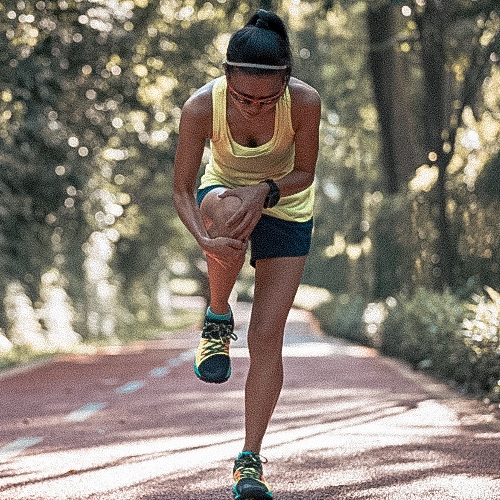
Irritation and swelling of the fat pad beneath the kneecap causing anterior knee pain.
Patellar fat pad irritation, also known as infrapatellar fat pad (IFP) impingement or Hoffa's fat pad syndrome, is a condition in which the fat pad located just below the kneecap becomes inflamed, swollen, or pinched between the bones of the knee joint. First described by German surgeon Albert Hoffa in 1904, this condition is a recognized but frequently underdiagnosed source of anterior knee pain that can significantly limit daily activities, sport participation, and overall quality of life.
The infrapatellar fat pad is one of the largest fat pads in the body and sits in the anterior compartment of the knee, occupying the space between the patellar tendon in front and the femoral condyles behind. When this tissue becomes irritated, it swells and can become trapped, or impinged, between the patella (kneecap) and the femoral trochlea (the groove at the front of the thighbone) during knee movement. This impingement creates a cycle of inflammation, further swelling, and increased vulnerability to repeated pinching, which can lead to chronic pain if left untreated.
While patellar fat pad irritation is closely related to Hoffa's syndrome, the two terms are sometimes used interchangeably in clinical settings. In the strictest sense, Hoffa's disease refers to a chronic hypertrophic and fibrotic state of the fat pad, whereas fat pad irritation encompasses the earlier, more acute inflammatory stages as well. Regardless of the terminology, the hallmark symptom is a burning or aching sensation deep to, and on either side of, the patellar tendon near the lower pole of the kneecap. Pain is usually worst when the knee is fully straightened, during active extension movements, or after prolonged sitting with the knees bent.
This condition affects a broad range of people, from young athletes involved in jumping and running sports to older adults dealing with degenerative knee changes, and it is also a well-recognized complication following knee surgery, particularly anterior cruciate ligament (ACL) reconstruction. It is more common in women, which may be partly explained by anatomical differences such as wider pelvic width and greater knee valgus angles (Dragoo et al., 2012; Vera et al., 2023).
The good news is that patellar fat pad irritation responds well to conservative physiotherapy treatment in the majority of cases. With the right combination of activity modification, taping, targeted strengthening, and manual therapy, most patients experience significant improvement within 8 to 12 weeks.
Understanding the anatomy of the infrapatellar fat pad helps explain why it is so susceptible to irritation and impingement.
The infrapatellar fat pad, also called Hoffa's fat pad, is an extrasynovial but intracapsular structure. This means it sits inside the fibrous capsule of the knee joint but lies outside the synovial membrane that lines the joint cavity. It is composed primarily of adipose (fatty) tissue interspersed with blood vessels and nerve fibres and occupies the space in the anterior knee between several key structures:
Cadaveric research has revealed that the fat pad is more anatomically complex than previously thought. Gallagher et al. (2020) demonstrated that in 81% of specimens, the IFP had supero-medial extensions that wrapped around the patella, and in 65% there were supero-lateral extensions as well. These extensions mean the fat pad has a much larger footprint and a closer relationship with the patella than traditionally depicted in textbooks.
The fat pad is a highly dynamic structure. During knee flexion it retracts posteriorly into the joint, and during extension it moves anteriorly away from the tibia (Macchi et al., 2018). This constant movement means the tissue is repeatedly deformed and displaced with every step, squat, and stair climb, making it particularly vulnerable to being caught between the hard surfaces of the patella and the femur when anything goes wrong with the normal mechanics of the knee.
Critically, the infrapatellar fat pad is one of the most richly innervated structures in the knee. It contains substance P nerve fibres and other nociceptive (pain-sensing) nerve endings, which explains why, when inflamed, it can be an extremely potent source of anterior knee pain (Dragoo et al., 2012). The fat pad also has an extensive blood supply, which, while advantageous for healing, means that trauma or inflammation can rapidly lead to significant swelling.
Patellar fat pad irritation can develop from a single traumatic event or from repetitive microtrauma over time. The most common causes and contributing factors include:
Repetitive or forceful hyperextension of the knee is one of the most frequently cited mechanisms of fat pad impingement. When the knee straightens beyond its normal range, the inferior pole of the patella can compress and pinch the fat pad against the femoral condyles. This is particularly common in activities that involve repeated kicking, jumping, or locking of the knee in full extension, such as dance, gymnastics, football, and martial arts.
A direct blow to the front of the knee, such as a fall onto the kneecap, a dashboard injury in a motor vehicle collision, or contact during sport, can cause bleeding and inflammation within the fat pad. The resulting swelling increases the volume of the tissue, making it more likely to become impinged during subsequent knee movement.
Patellar fat pad irritation is a well-documented complication following knee surgery. It is especially prevalent after ACL reconstruction, where surgical instruments and graft harvest can cause direct trauma to the fat pad. Post-operative scarring and fibrosis within the anterior interval of the knee can further limit normal fat pad mobility, predisposing it to ongoing impingement. Arthroscopic surgery of any kind can also introduce bleeding into the fat pad, initiating the inflammatory cycle (Mace et al., 2016).
Several biomechanical predispositions increase the risk of fat pad irritation:
Athletes and active individuals who engage in high volumes of running, jumping, squatting, or stair climbing may develop gradual fat pad irritation through cumulative microtrauma. The fat pad deforms with every repetition of knee movement, and excessive loading without adequate recovery can push the tissue beyond its capacity to self-repair.
Obesity, hormonal changes, and osteoarthritis have all been associated with fat pad abnormalities. In osteoarthritis, the fat pad can become chronically inflamed and contribute to both pain and disease progression through the release of inflammatory mediators (Clockaerts et al., 2010).
Physiotherapy is widely recognized as the primary and most effective treatment for patellar fat pad irritation. Research consistently demonstrates that the majority of patients achieve full resolution of symptoms with conservative management, making surgery unnecessary in most cases (StatPearls, 2024; Dragoo et al., 2012).
The rationale for physiotherapy centres on addressing the root causes and perpetuating factors of the condition rather than simply managing symptoms. Whereas rest alone may temporarily reduce pain, it does not correct the underlying biomechanical dysfunctions, muscle imbalances, or movement patterns that led to the fat pad becoming irritated in the first place. Without targeted rehabilitation, the condition commonly recurs once normal activities are resumed.
Physiotherapy offers several specific advantages for fat pad irritation:
A physiotherapist can also determine whether contributing factors such as patella alta, genu recurvatum, or post-surgical scarring are playing a role, and tailor the treatment plan accordingly. This individualized approach is crucial because the causes and contributing factors vary significantly from patient to patient.
The timeline for recovery from patellar fat pad irritation varies depending on the severity of the condition, how long symptoms have been present before treatment begins, and the individual's adherence to the rehabilitation programme.
The initial focus is on reducing pain and inflammation. This typically involves activity modification, avoidance of aggravating movements (particularly sustained full extension and prolonged sitting), ice application, anti-inflammatory measures, and patellar taping to offload the fat pad. Patients often notice a meaningful reduction in resting pain during this phase.
As pain settles, rehabilitation progresses to include gentle range-of-motion exercises, closed-chain quadriceps strengthening (such as mini squats and leg presses through a pain-free range), and gluteal activation work. Manual therapy techniques to improve fat pad mobility may be introduced. Taping continues as needed.
The emphasis shifts to progressive strengthening, neuromuscular control, and return to functional activities. Exercises become more challenging and sport-specific where applicable. Running, jumping, and higher-load activities are gradually reintroduced using a pain-guided approach.
Most patients with acute or subacute fat pad irritation recover fully within 8 to 12 weeks of beginning structured physiotherapy. However, chronic cases where symptoms have been present for many months may take up to 6 months for complete resolution. The duration of symptoms prior to beginning treatment is a strong predictor of recovery time: the longer the condition has been present, the longer it typically takes to resolve.
It is important to note that surgical intervention (arthroscopic debridement or partial resection of the fat pad) is only considered when a patient has failed a minimum of 3 months of dedicated conservative management.
A comprehensive physiotherapy treatment programme for patellar fat pad irritation typically includes the following components:
Taping is one of the most effective and immediate interventions for fat pad irritation. A specific taping technique is used to lift the inferior pole of the patella, which shortens and unloads the inflamed fat pad and reduces the mechanical compression during knee movement. Patients often report significant pain relief within minutes of tape application. Taping is used as an adjunct to active rehabilitation and is gradually weaned as symptoms improve and muscle strength increases.
Strengthening the quadriceps, with particular attention to the vastus medialis obliquus (VMO), is a cornerstone of treatment. The VMO plays a critical role in patellar tracking, and weakness in this muscle is commonly observed in patients with anterior knee pain. Rehabilitation typically begins with isometric quadriceps contractions and progresses to closed-chain exercises such as wall sits, step-ups, and leg presses, performed through a pain-free range of motion. Research has shown that quadriceps strengthening produces greater improvements than taping alone, and that combining the two yields the best outcomes (Cowan et al., 2002).
Gentle knee flexion and extension exercises are prescribed to maintain and restore full range of motion while respecting pain limits. End-range extension is initially avoided to prevent further impingement but is gradually reintroduced as inflammation resolves. Maintaining mobility is particularly important after knee surgery to prevent the fat pad from becoming scarred and adherent within the anterior interval.
Hands-on treatment techniques may include soft tissue mobilization of the fat pad and surrounding tissues, patellar mobilization to improve tracking and reduce compression, and joint mobilization to address any stiffness in the tibiofemoral or patellofemoral joints. While the evidence for manual therapy as an isolated intervention is limited, it can be a useful component of a comprehensive programme, particularly in chronic or post-surgical cases where fibrosis and adhesion formation are contributing to ongoing symptoms (Dragoo et al., 2012).
Weakness of the hip abductors (particularly the gluteus medius) and external rotators can contribute to excessive knee valgus and altered patellar loading. Incorporating hip strengthening and pelvic stability exercises into the programme helps to optimize lower limb mechanics and reduce the forces acting on the fat pad during weight-bearing activities.
Patients are educated about positions and activities that aggravate fat pad impingement, most notably sustained full knee extension, prolonged sitting with the knee bent, and high-impact loading before the tissue has adequately recovered. A graduated return-to-activity programme is designed to progressively increase load while staying within the tissue's capacity to tolerate stress.
In some cases, non-steroidal anti-inflammatory medications (NSAIDs) or corticosteroid injections may be used alongside physiotherapy to manage acute inflammation. Cryotherapy (ice) is commonly recommended in the early stages for symptom relief.
While not all cases of patellar fat pad irritation can be prevented, several strategies can significantly reduce the risk:
Patellar fat pad irritation typically causes a burning or aching pain at the front of the knee, localized deep to and on either side of the patellar tendon near the bottom of the kneecap. Pain is usually worst when the knee is fully straightened, during activities that involve kicking or extending the leg, and after prolonged sitting. Some patients also notice swelling around the lower part of the kneecap.
Diagnosis is primarily clinical. Your physiotherapist or physician will perform a physical examination that includes Hoffa's test, which involves pressing on either side of the patellar tendon with the knee slightly bent and then straightening the knee. If this reproduces your pain, it is a positive sign for fat pad impingement. MRI can confirm the diagnosis by showing swelling or oedema within the fat pad, though it is not always necessary.
The terms are closely related and often used interchangeably. Technically, Hoffa's syndrome or Hoffa's disease refers to a chronic state where the fat pad has become hypertrophied (enlarged) and fibrotic (scarred), while patellar fat pad irritation can encompass the earlier acute inflammatory stages as well. The treatment approach is similar for both.
Mild cases may settle with rest and activity modification, but without addressing the underlying biomechanical factors, the condition commonly recurs. Physiotherapy significantly improves outcomes and reduces the risk of the condition becoming chronic. Most cases resolve fully within 8 to 12 weeks of structured treatment.
The vast majority of patients do not require surgery. Conservative management with physiotherapy is the recommended first-line treatment and is successful in most cases. Surgery, typically arthroscopic debridement or partial resection of the fat pad, is only considered after at least 3 months of dedicated conservative treatment has failed to provide adequate relief.
Yes, but with modifications. Avoiding activities that provoke significant pain, particularly those involving forceful knee extension, deep squats, or high-impact loading, is important in the early stages. Your physiotherapist will guide you through a graduated exercise programme that keeps you active while allowing the fat pad to recover.
Avoid sleeping with the knee fully straight or hyperextended. Placing a small pillow or rolled towel under the knee to maintain a slight bend can help reduce pressure on the fat pad overnight.
Patellar fat pad irritation can be a frustrating and painful condition, but with the right treatment, the prognosis is excellent. At Vaughan Physiotherapy, our experienced team uses evidence-based techniques including targeted taping, progressive strengthening, manual therapy, and individualized movement retraining to help you recover fully and get back to the activities you love.
Do not wait for the pain to become chronic. Early intervention leads to faster recovery and better outcomes.
Call us today at 905-669-1221 to book your assessment, or visit us at 398 Steeles Ave W, Unit 201, Thornhill, Ontario.
Let our team help you move without pain again.
Recover faster, move better, and feel stronger with expert physiotherapy. Our team is here to guide you every step of the way.

Explore the latest articles written by our clinicians