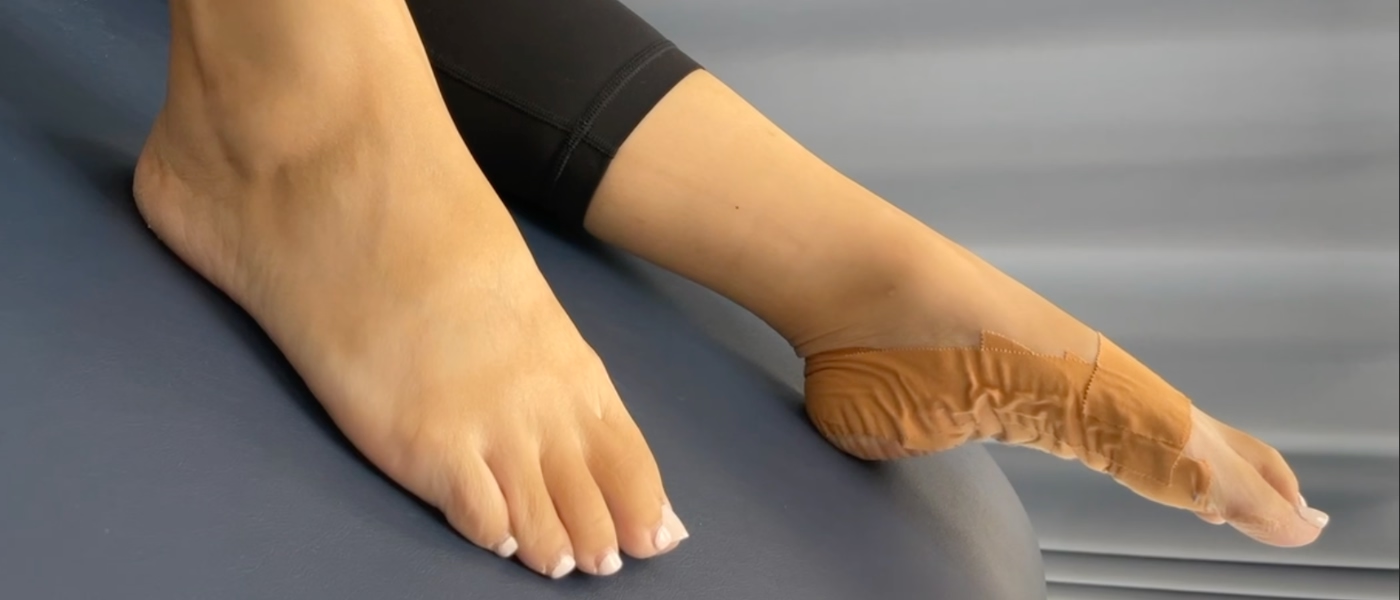
Habitual or pathological toe walking pattern requiring gait assessment and physiotherapy intervention.
Toe walking is a gait pattern in which an individual walks on the forefoot — the toes and ball of the foot — without making normal initial heel contact during the stance phase of walking. In a typical gait cycle, the heel strikes the ground first, followed by a smooth roll through the midfoot and push-off from the toes. In toe walkers, this sequence is disrupted: the forefoot contacts the ground first, or the heel never contacts the ground at all.
The most common clinical presentation is idiopathic toe walking (ITW), a diagnosis of exclusion assigned when no identifiable neurological, orthopaedic, or developmental cause can be found. Pomarino, Ramirez Llamas, and Martin (2017) conducted a comprehensive literature review and reported that ITW affects an estimated 5 to 12 percent of otherwise healthy children, with many cases resolving spontaneously by age five or six. However, a significant subset persists into later childhood and even adulthood if left unaddressed.
Bauer, Sienko, and Davids (2022), writing in the Journal of the American Academy of Orthopaedic Surgeons, provided an updated clinical framework noting that ITW remains a diagnosis of exclusion — clinicians must first rule out cerebral palsy, muscular dystrophy, autism spectrum disorder, and other conditions before confirming the idiopathic label.
Some children develop toe walking purely out of habit. They can walk with a normal heel-strike pattern when asked but default to forefoot walking during everyday activities. Over time, habitual toe walking can lead to adaptive shortening of the calf muscles and Achilles tendon, making it progressively harder to achieve a flat-footed stance.
Toe walking may also be a presenting sign of:
Williams, Tinley, and Curtin (2010) published one of the earliest studies linking ITW with sensory processing dysfunction, finding that children who toe walk often demonstrate atypical sensory profiles, particularly in tactile and vestibular processing. More recently, Donne, Powell, and Fahey (2023) conducted a systematic review confirming that while some children with ITW display measurable sensory processing difficulties, not all do — reinforcing the heterogeneous nature of the condition.
Understanding why toe walking occurs requires a working knowledge of the structures that control ankle motion and foot positioning during gait.
Dorsiflexion is the movement of pulling the foot upward toward the shin. A minimum of approximately 10 degrees of ankle dorsiflexion is required for a normal heel-strike gait pattern. When dorsiflexion is limited — whether from muscle tightness, joint restriction, or neurological tone — the body compensates by shifting weight onto the forefoot.
The posterior compartment of the lower leg contains two key muscles:
Together, these muscles form the triceps surae complex, which merges into the Achilles tendon.
The Achilles tendon is the thickest and strongest tendon in the body, transmitting the force of the calf muscles to the calcaneus (heel bone) to produce plantarflexion. In chronic toe walkers, the Achilles tendon and surrounding soft tissues can undergo adaptive shortening and increased stiffness, creating an equinus contracture — a fixed limitation in dorsiflexion that perpetuates the toe-walking pattern.
The longitudinal and transverse arches of the foot rely on a complex interplay of ligaments, fascia, and small intrinsic muscles. Toe walkers frequently develop altered loading patterns that can affect arch development, potentially contributing to pes cavus (high arches) or, paradoxically, collapsing arches due to compensatory pronation.
Recover faster, move better, and feel stronger with expert physiotherapy. Our team is here to guide you every step of the way.

The causes of toe walking span a spectrum from benign habitual patterns to serious neurological conditions. A systematic clinical approach is essential.
Many young children begin toe walking during the normal transition from supported to independent walking. In most cases, this resolves naturally. When it persists without an identifiable pathological cause, it is classified as habitual or idiopathic. Bauer et al. (2022) noted that approximately half of children with ITW have a positive family history, suggesting a possible genetic component.
Shortening of the gastrocnemius-soleus complex is both a cause and a consequence of persistent toe walking. As the child continues to walk on the forefoot, the calf muscles and Achilles tendon adapt to the shortened position, creating a self-reinforcing cycle. Brouwer, Davidson, and Olney (2000) demonstrated that this contracture pattern is measurably similar in idiopathic toe walkers and children with mild spastic cerebral palsy, highlighting the importance of early intervention regardless of the underlying cause.
Some children toe walk because they are seeking or avoiding specific sensory input through the soles of their feet. Williams, Tinley, and Curtin (2010) identified that children with ITW scored significantly differently on standardized sensory processing measures compared to age-matched controls. The tactile and proprioceptive systems appear most commonly involved.
Upper motor neuron conditions such as cerebral palsy produce spasticity in the plantarflexor muscles, making heel contact biomechanically difficult. Lower motor neuron conditions and neuromuscular disorders can cause weakness that alters gait mechanics. Spinal cord pathology such as a tethered cord may present initially as toe walking before other neurological signs become apparent.
Congenital short Achilles tendon, leg length discrepancy, and bony abnormalities of the foot or ankle can all produce or contribute to a toe-walking pattern.
A thorough assessment is the cornerstone of effective treatment. At Vaughan Physiotherapy, our assessment for toe walking includes:
Physiotherapy is the first-line conservative treatment for toe walking across all age groups. Williams, Gray, and Davies (2020) surveyed health professionals managing ITW and found that physiotherapy-led stretching programs were the most commonly recommended initial intervention, with serial casting and surgical lengthening reserved for refractory cases.
Progressive stretching of the gastrocnemius and soleus muscles restores ankle dorsiflexion range of motion. Both sustained static stretches and dynamic stretching techniques are employed, with evidence supporting a minimum of 30-second hold times repeated multiple times daily for meaningful tissue adaptation.
While the calf muscles may be short and tight, they are often functionally weak in their lengthened range. Eccentric strengthening — loading the muscle as it lengthens — is particularly effective for building strength through the full range of dorsiflexion. Additionally, strengthening the tibialis anterior and intrinsic foot muscles helps rebalance the forces around the ankle.
Conscious gait retraining teaches the patient to initiate each step with a heel strike. This is progressed from slow, deliberate walking with verbal and tactile cueing to automatic heel-strike walking at normal speed.
Yes. Many toddlers toe walk intermittently during the first year or two of independent walking. This typically resolves by age two to three. If toe walking persists beyond age three, or if it is the exclusive walking pattern, a professional assessment is recommended.
While toe walking is most commonly identified in childhood, adults can develop a forefoot-dominant gait pattern due to Achilles tendon shortening from prolonged high-heel use, neurological conditions, or compensatory patterns following injury.
Most children with toe walking respond well to conservative physiotherapy management. Surgical Achilles tendon lengthening is typically reserved for severe, fixed contractures that have not responded to a comprehensive trial of physiotherapy, serial casting, and bracing.
Calf stretching should be performed 2 to 3 times daily, with each stretch held for at least 30 seconds. Strengthening and gait retraining exercises are typically prescribed 4 to 5 times per week. Consistency is more important than intensity.
Untreated chronic toe walking can lead to permanent Achilles tendon shortening, altered foot bone development, knee and hip compensatory problems, and increased fall risk. Early intervention significantly reduces these risks.
Orthotics alone do not treat toe walking, but they can be a valuable component of a comprehensive program. Custom ankle-foot orthoses can maintain dorsiflexion range between therapy sessions.
If you or your child walks on their toes and you are concerned about the pattern, our team at Vaughan Physiotherapy can help. We provide comprehensive gait assessments, individualized treatment programs, and ongoing support to restore a normal, efficient walking pattern. Book an appointment today or call our clinic to discuss your concerns with one of our experienced physiotherapists.
Explore the latest articles written by our clinicians