Lumbar Spine
Acupuncture
If you've lived with low back pain for more than a few months, you've probably already tried the usual suspects: stretching, painkillers, maybe a round of physiotherapy. So where does acupuncture fit in? It's one of the most-studied complementary therapies for back pain, and thanks to a wave of recent research, we finally have a clearer picture of what it can and can't do.
Here's what the science actually shows, translated out of research-speak.
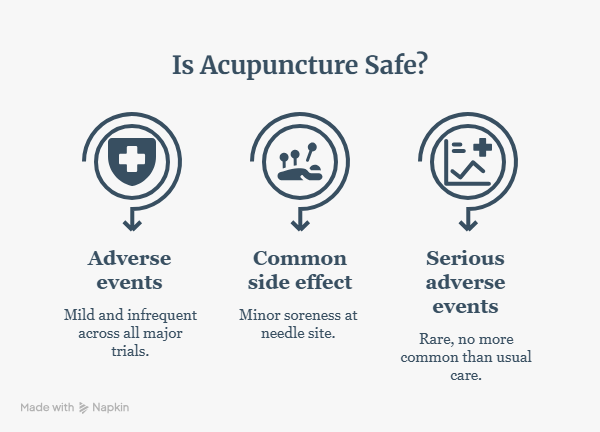
Acupuncture won't cure chronic low back pain, and it isn't magic. But across dozens of clinical trials involving thousands of people, it consistently comes out ahead of doing nothing, and it holds up reasonably well against standard care like physiotherapy, medication, and exercise. It's also remarkably safe, with side effects rarely amounting to more than mild soreness at the needle site.
The nuance is in the comparisons. How much acupuncture helps depends heavily on what you're comparing it to.
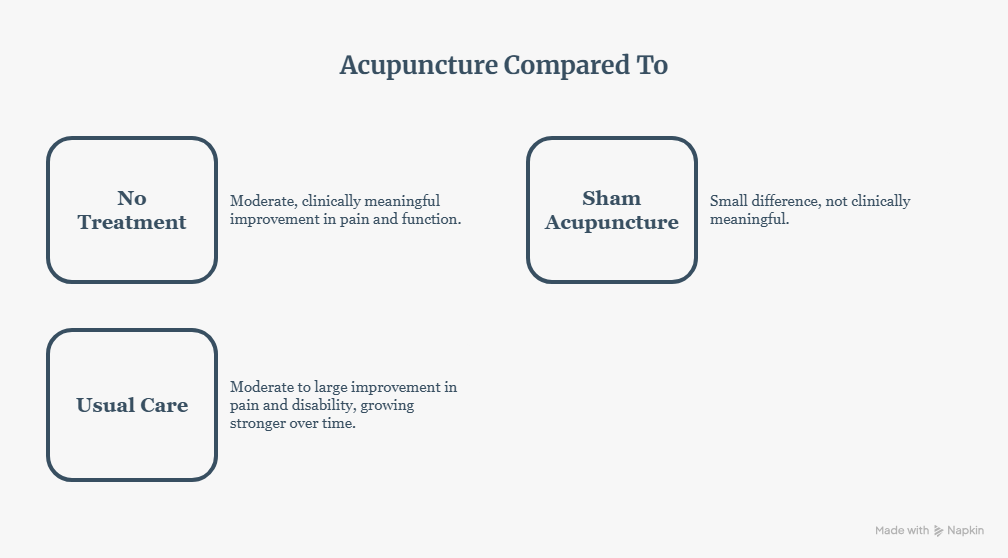
A major 2020 Cochrane review, one of the most rigorous forms of medical evidence available, pooled data from 33 studies and over 8,000 people with chronic low back pain. Compared to people who received no treatment at all, those who got acupuncture reported meaningfully less pain and better back function. This was rated moderate-certainty evidence, meaning researchers are fairly confident the effect is real.
Here's where it gets interesting. Many rigorous trials compare real acupuncture to "sham" acupuncture, needling at incorrect points, or using retractable needles that don't actually pierce the skin, as a placebo control. When compared this way, the Cochrane review found that real acupuncture only slightly outperformed sham treatment, not enough to be considered clinically meaningful for pain or quality of life.
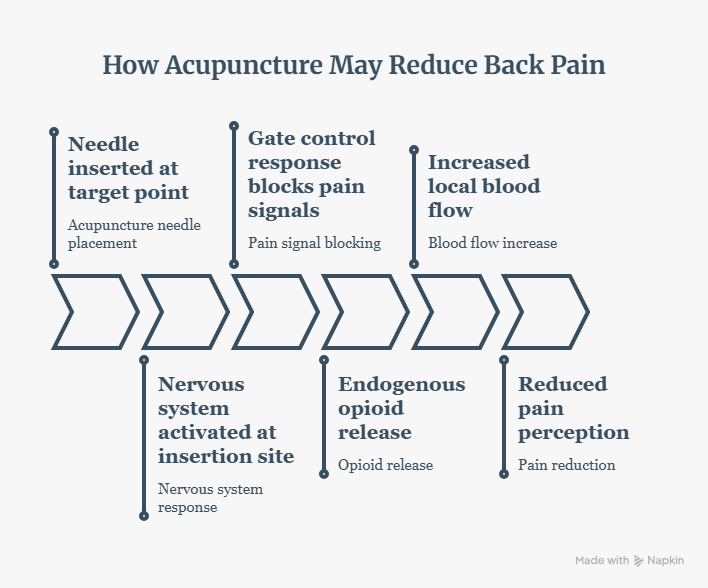
This doesn't necessarily mean acupuncture "doesn't work." It suggests that some of its benefit may come from factors shared with sham treatment: the ritual of care, focused attention from a practitioner, and the body's own pain-modulating responses to needling, real or simulated. Researchers have proposed several biological mechanisms for how real needling works, including the "gate control" theory of pain, the release of the body's natural opioids, and increased local blood flow, but separating these effects from the power of expectation and touch has proven difficult in sham-controlled trials.
Interestingly, a 2025 commentary in the same field argued that older Cochrane-style reviews may actually underestimate acupuncture's real-world value, because sham needling isn't a truly inert placebo. It still stimulates nerve endings and can produce some physiological response of its own.
This comparison, real acupuncture against standard treatments like physiotherapy, exercise, and medication, is arguably the most practically useful one, since it reflects the actual choice most people are making.
A 2026 systematic review pooling 8 randomized trials and over 1,100 participants found that acupuncture produced significantly greater reductions in both pain and disability than usual care, and the benefit grew stronger over time. At the 2-week mark, the effect on pain was moderate to large; by 2 to 6 months out, it was even larger. Disability scores followed the same pattern. The catch: the certainty of this evidence was rated low to very low, mainly because many trials couldn't blind participants to which treatment they were getting (hard to do when one involves needles and the other doesn't), and because of a suspected tendency for studies with positive results to get published more often than those with disappointing ones.
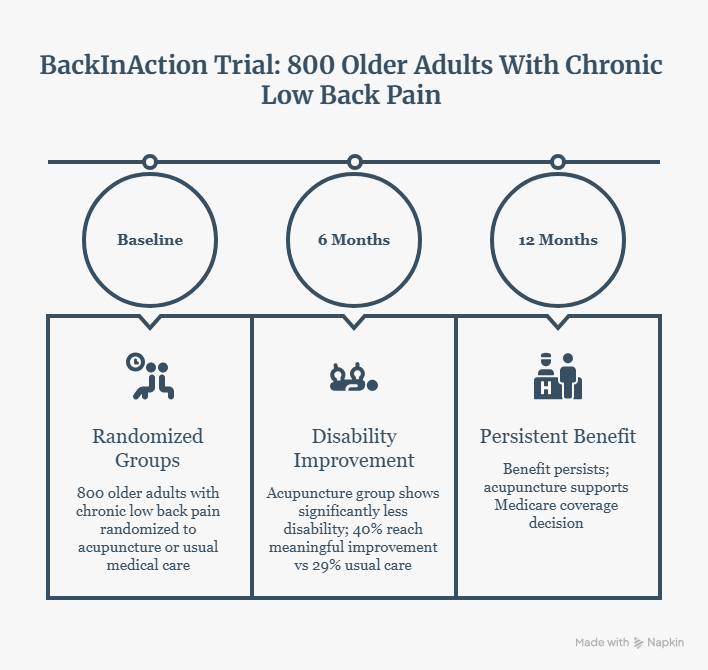
The most compelling recent study is a large, pragmatic clinical trial published in JAMA Network Open in September 2025, funded by the NIH specifically to help inform Medicare's coverage decisions for acupuncture. Researchers followed 800 adults aged 65 and older with chronic low back pain across four U.S. health systems, randomly assigning them to standard acupuncture, "enhanced" acupuncture (standard plus extra maintenance sessions), or usual medical care alone.
The results were consistent and durable. At 6 months, people receiving acupuncture reported meaningfully less back-related disability than those on usual care alone, and the gap was still present a full year later. Close to twice as many acupuncture patients hit the threshold for a "clinically meaningful" improvement compared to those receiving usual care alone (roughly 40-44% versus 29%). Acupuncture patients also reported notable drops in anxiety, a common companion to chronic pain that's easy to overlook.
Just as important: this was one of the largest and best-designed studies to look specifically at older adults, a group often underrepresented in pain research despite carrying the highest burden of chronic back pain. Serious side effects were rare and no more common in the acupuncture groups than in usual care, with the most frequent complaint simply being mild discomfort at the needle site.
The research on acupuncture for chronic low back pain has matured considerably in the last few years. It's not a miracle cure, and the certainty of the evidence varies from moderate to very low depending on the comparison. But taken together, the studies point to a therapy that is safe, reasonably effective compared to usual care and no treatment, and worth a conversation with your healthcare provider, particularly as part of a broader plan that includes movement, physiotherapy, and other evidence-based strategies for managing chronic pain.
If you're dealing with chronic low back pain and want to talk through your options, our team is always happy to help you figure out what combination of treatments makes sense for you.
Recover faster, move better, and feel stronger with expert physiotherapy. Our team is here to guide you every step of the way.


