Condition guide
Postpartum Pelvic Instability
Pain and a feeling of weakness or looseness in the pelvic joints after childbirth, also called postpartum pelvic girdle pain.
Since having your baby, does your pelvis feel sore, weak, or "loose"? Do you get a deep ache at the back of the pelvis or a sharp pain at the front when you climb stairs, roll over in bed, get out of the car, or stand on one leg to put on your pants? If so, you may be dealing with postpartum pelvic instability, more formally known as pelvic girdle pain after pregnancy.
At Vaughan Physiotherapy Clinic, we assess and treat pelvic pain in new mothers, from the first few weeks after delivery to pain that has lingered for months or years. Our team includes a pelvic health physiotherapist, so we can look at the whole picture: the pelvic joints, the hips and trunk, the abdominal wall, and the pelvic floor. The goal is to help you move and care for your baby with confidence.
Here is what postpartum pelvic instability is, how to recognize it, what else it could be, and what the research says about treating it.
What Is Postpartum Pelvic Instability?
Your pelvis is a ring made of three bones held together by three joints: the two sacroiliac (SI) joints at the back and the pubic symphysis at the front. During pregnancy and birth, these joints and the tissues around them are placed under a lot of strain. For some women, pain in these joints continues after the baby arrives.
Researchers and clinicians call this pelvic girdle pain (PGP). It is pain felt between the top of the back of the pelvis and the crease of the buttock, especially near the SI joints. It can spread into the back of the thigh, and it can also be felt at the pubic bone at the front (Vleeming et al., 2008; Stuge, 2012). Many women describe the pelvis as feeling "unstable" or "out of place," but in most cases the joints are not dislocated. The feeling usually reflects pain and difficulty controlling the pelvis under load.
Pelvic girdle pain is common. About 1 in 5 pregnant women have it at any given time (Vleeming et al., 2008). Most women recover soon after delivery, but a smaller group keeps having trouble for months or longer (Stuge, 2012). In one study of 411 women, PGP was diagnosed in 9 percent within the first three days after birth, and about 16 percent of those who replied at six weeks still reported it (Starzec-Proserpio, Węgrzynowska et al., 2022).
Types of Postpartum Pelvic Pain
Pelvic girdle pain can show up in different parts of the ring (Vleeming et al., 2008; Stuge, 2012):
- Back of the pelvis: pain over one or both SI joints, sometimes spreading into the buttock or back of the thigh
- Front of the pelvis: pain over the pubic bone, often called symphysis pubis dysfunction
- Whole pelvis: pain at the front and both sides of the back at the same time, which tends to be more limiting
- Pubic symphysis separation: a rare, more serious injury where the joint at the front widens during labour. It usually causes severe pain from the time of delivery and needs medical assessment (Urraca-Gesto et al., 2015)
Understanding the Anatomy
- Sacroiliac joints: the two joints where the base of the spine (sacrum) meets the pelvic bones. They move only a small amount and rely on ligaments and muscles for support
- Pubic symphysis: the joint at the front of the pelvis, where the two pubic bones are joined by a disc of cartilage
- Pelvic floor: a sling of muscles across the bottom of the pelvis that supports the bladder, bowel, and uterus, and works with the deep abdominal and back muscles to help control the pelvis
- Abdominal wall and hip muscles: the "six-pack" muscle, which can separate in pregnancy (diastasis recti), and the buttock muscles that keep the pelvis level
Recognizing the Symptoms
- Deep aching or sharp pain at the back of the pelvis, over the pubic bone, or both
- Pain or a clicking, catching, or grinding feeling at the front or back of the pelvis
- Pain when rolling over in bed, getting in and out of the car, or changing position (Starzec-Proserpio, Węgrzynowska et al., 2022)
- Trouble standing, walking, or sitting for as long as you normally would (Vleeming et al., 2008)
- Pain when standing on one leg, such as when climbing stairs or getting dressed
- A feeling that your leg is heavy or hard to lift when lying on your back
- Pain that builds through the day and is often worse in the evening
What Makes It Worse?
- Single-leg loading: stairs, stepping into the bath, putting on pants, or walking with long strides
- Asymmetric positions: carrying the baby or car seat on one hip, or standing with your weight on one leg
- Long periods in one position: standing, walking, or long feeds in an unsupported chair
- Doing too much too soon: a sudden return to long walks, lifting, or exercise classes
- Your history: women who had more severe pain in pregnancy, more painful clinical tests, a history of low back pain, or higher disability during pregnancy are more likely to have pain that lasts after delivery (Burani et al., 2023). A previous injury to the pelvis is also a likely risk factor (Vleeming et al., 2008)
- Fear and worry about movement: high fear of movement during pregnancy has been linked to pain persisting after birth (Burani et al., 2023)
What Else Could It Be?
Several conditions can cause pain in or around the pelvis after birth. Part of our assessment is telling them apart:
- Low back pain: pain higher up, above the pelvis, often linked to bending. Low back pain and pelvic girdle pain can happen together, but they are assessed and treated a little differently (Vleeming et al., 2008)
- Pubic symphysis separation: severe pain at the front of the pelvis starting at delivery, sometimes with a felt or heard "pop" and great difficulty walking (Urraca-Gesto et al., 2015)
- Hip problems: pain in the groin with hip movement, such as a labral tear or, rarely, a stress fracture of the hip or pelvis
- Tailbone pain: pain at the coccyx, mainly when sitting
- Pelvic floor or perineal pain: pain from a tear, stitches, or tight pelvic floor muscles, often felt inside the pelvis or with sitting, bowel movements, or intercourse
- Sciatica: pain, numbness, or tingling below the knee from the lower back
- Inflammatory arthritis: such as ankylosing spondylitis, which can affect the SI joints and cause morning stiffness. MRI can help rule this out when it is suspected (Vleeming et al., 2008)
When to See a Doctor First
Contact your doctor, midwife, or go to urgent care if you have:
- Severe pain at the pubic bone from the time of delivery, a pop or gap you can feel, or you cannot walk or bear weight
- Fever, chills, or a hot, red, very tender area, including around a caesarean or perineal wound
- A swollen, warm, painful calf or sudden shortness of breath or chest pain, which can be signs of a blood clot and need emergency care
- Heavy vaginal bleeding or bleeding that is increasing rather than settling
- New loss of bladder or bowel control, numbness around the genitals or inner thighs, or weakness in your legs
- Constant pain that does not change with position, pain at night that wakes you, or a known history of cancer
- Low mood, anxiety, or thoughts of harming yourself or your baby, which deserve care just as much as physical pain
Our physiotherapists screen for these signs at your first visit and will coordinate with your family doctor, midwife, or obstetrician if imaging or a referral is needed.
Related reading: You may also find our guides to pelvic girdle pain, postpartum core rehabilitation and diastasis recti helpful.
Why Physiotherapy Is Essential
Postpartum pelvic pain is often brushed off as something that will "settle on its own," and for many women it does. But research summarized in a recent review suggests that about one third still have symptoms three months after birth, and a smaller group still has significant symptoms two years later (Burani et al., 2023). Waiting it out is not always the best plan when you are caring for a newborn every day.
The European guidelines for pelvic girdle pain recommend an individualized program that addresses several factors at once for women whose pain continues after pregnancy, along with clear information and reassurance (Vleeming et al., 2008).
Physiotherapy addresses the main drivers:
- Pelvic control: retraining the deep trunk, pelvic floor, hip, and buttock muscles that help hold the pelvis steady under load
- The pelvic floor and abdominal wall: both can change after pregnancy, and both may be linked to pelvic girdle pain after birth (Starzec-Proserpio, Rejano-Campo et al., 2022)
- Daily load: changes to how you lift, carry, and feed so the pelvis can settle
- Confidence: reducing the fear of movement that can keep pain going (Burani et al., 2023)
Your Treatment Plan at Vaughan Physiotherapy Clinic
Phase 1: Assessment (First Visit)
Your first visit focuses on finding where the pain comes from and what keeps it going. It includes:
- History: your pregnancy, delivery, any tears or caesarean section, and which daily tasks are hardest
- Screening: checking for the warning signs listed above
- Pelvic pain tests: the European guidelines recommend a group of simple tests, including the posterior pelvic pain provocation (P4) test, Patrick's (FABER) test, Gaenslen's test, the modified Trendelenburg test, pressing on the long dorsal ligament and the pubic symphysis, and the active straight leg raise (Vleeming et al., 2008). Several tests together are more accurate than any one alone (Stuge, 2012)
- Back, hip, and movement screen: ruling out the spine and hip, and watching how you stand on one leg, climb a step, and lift
- Abdominal wall check: the gap between the abdominal muscles and how well the wall holds tension
Pelvic floor assessment
Our pelvic health physiotherapist can assess the pelvic floor when it is appropriate and you are comfortable with it. In a study comparing 28 women with postpartum pelvic girdle pain to 28 matched women without pain, the women with pain had lower pelvic floor resting tone, more pelvic floor tenderness, and more difficulty contracting the pelvic floor on purpose. They also had a wider gap between the abdominal muscles. Pelvic floor strength and endurance were not different between the groups (Starzec-Proserpio, Rejano-Campo et al., 2022). The authors recommended individual pelvic floor and abdominal wall assessment in women with postpartum PGP.
The evidence is mixed. A larger study that checked women within three days of birth found no link between pelvic floor function and PGP at that early point (Starzec-Proserpio, Węgrzynowska et al., 2022), so we assess first rather than assuming everyone needs the same program. Internal examination is always optional, explained in advance, and usually done after your postnatal check with your doctor or midwife.
Phase 2: Settling Pain and Protecting the Pelvis
Early care calms things down while keeping you moving:
- Information and reassurance: a core part of care in the guidelines (Vleeming et al., 2008)
- Load management: breaking up long periods of standing and walking, taking shorter strides, and using stairs one step at a time while pain is high
- Knees together: getting in and out of the car and bed with the knees together
- Baby care set-up: supported feeding positions, a change table at waist height, and carrying the baby close to your centre rather than on one hip
- Pelvic support belt: some women find a belt helps in the short term. The evidence for belts is limited (Stuge, 2012), so we use them as a temporary aid
If a symphysis separation is suspected, we work with your physician; most cases are managed with a belt, side-lying rest, then stabilizing exercise (Urraca-Gesto et al., 2015).
Phase 3: Rebuilding Strength and Control (Weeks 2 to 20)
Specific stabilizing exercises
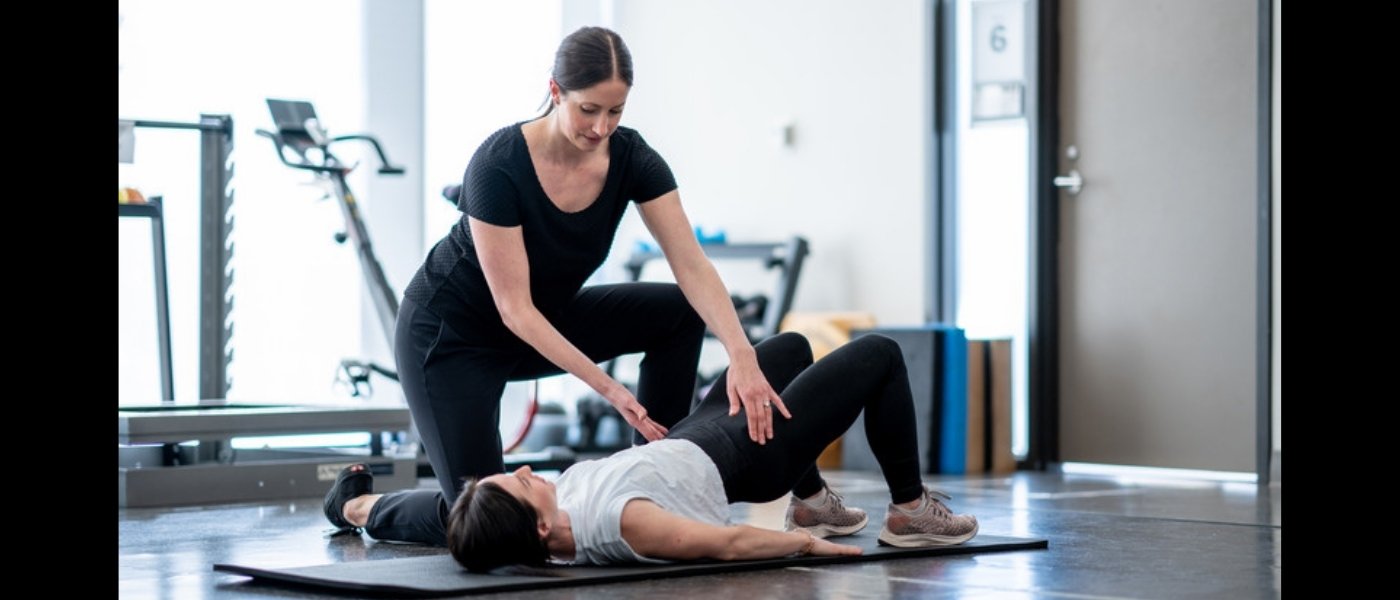
In a randomized trial of 81 women with pelvic girdle pain after pregnancy, a 20-week physiotherapy program focused on specific stabilizing exercises was compared with physiotherapy without those exercises. The exercise group had much less pain, less disability, and better quality of life, both right after the program and one year after delivery. Disability dropped by more than half in the exercise group, while the other group barely changed (Stuge et al., 2004). A later review of postpartum care rated the evidence for exercise in postpartum PGP as moderate (Weis et al., 2020).
Your tailored program may include:
- Deep abdominal activation: gently drawing in the lower abdomen while breathing normally
- Pelvic floor coordination: learning to contract and, just as importantly, fully relax the pelvic floor, guided by your assessment
- Bridging: lifting the hips from the floor, progressing to single-leg bridges
- Hip exercises: clamshells and side leg lifts for the buttock muscles that keep the pelvis level
- Functional strength: sit to stand, step-ups, split squats, and carrying, progressed as your control improves
Pelvic floor and abdominal wall rehabilitation
If your assessment shows a pelvic floor that is hard to activate, tender, or not relaxing well, or poor tension in the abdominal wall, our pelvic health physiotherapist will build that into your program. These findings were more common in women with postpartum PGP (Starzec-Proserpio, Rejano-Campo et al., 2022), but treating them directly has not yet been tested in trials for pelvic pain, so they form one part of a broader program. This work can also help with leaking, heaviness, or pain with intercourse.
Manual therapy
Gentle joint mobilization and soft tissue work can ease pain and stiffness so you can keep exercising. The evidence is too limited for a firm recommendation (Weis et al., 2020), so we use it alongside, not instead of, exercise.
Phase 4: Return to Full Activity
- Lifting and carrying: building up to the car seat, stroller, and a growing toddler
- Return to exercise and running: a staged plan that adds impact gradually
Beyond Physiotherapy: Complementary Care for Postpartum Pelvic Instability
Individualized exercise and education are the core of care, and that is where the research is clearest. Other services at our clinic can ease pain and tension so you stay consistent with rehab. Most of the research on these treatments was done during pregnancy rather than after birth, so it is indirect. Here is an honest summary.
How Acupuncture and Dry Needling Can Help
Acupuncture and dry needling use fine needles to reduce pain and ease tight, tender muscles.
- What the evidence shows: we did not find trials of acupuncture for pelvic girdle pain after delivery. In a trial of 386 pregnant women, adding acupuncture or stabilizing exercises to standard care both reduced pain, with acupuncture helping most (Elden et al., 2005). However, a later high-quality trial found no clear benefit of acupuncture over sham acupuncture (Stuge, 2012). There is no specific research on dry needling for this condition
- Where it fits: as a short-term option to ease pain and buttock or back muscle tension while you work on your exercise program
- Safety: generally very safe after delivery. Minor bruising or soreness is the most common side effect
How Massage Therapy Can Help
Registered massage therapy focuses on the soft tissues of the lower back, buttocks, and hips.
- What the evidence shows: there are no published trials of massage for postpartum pelvic girdle pain. A review of 10 studies in pregnant women, mostly testing massage and osteopathic treatment, found that manual therapies reduced pain compared with usual care or relaxation, but not compared with a sham treatment. The authors described the evidence as limited (Hall et al., 2016)
- Where it fits: it may ease muscle tension from feeding and carrying. We treat it as a supportive add-on
- Safety: very safe. Mention any recent caesarean wound
How Chiropractic and Joint Manipulation Can Help
Chiropractic care for the pelvis uses joint mobilization and manipulation of the SI joints, lower back, and hips.
- What the evidence shows: a review of chiropractic care after pregnancy found one trial supporting manipulation or mobilization for postpartum low back pain. For pelvic girdle pain, exercise had the strongest evidence, and the authors concluded that no treatment had enough evidence for a clear recommendation (Weis et al., 2020)
- Where it fits: for stiffness or pain in the lower back and hips that is limiting your movement, combined with exercise
- Safety: generally safe with a trained practitioner. Forceful techniques are avoided with a suspected symphysis separation, fracture, or infection
Whichever you choose, these treatments share one purpose: easing pain so you keep moving while the real fix, a stronger, better-controlled pelvis, takes hold.
When Is Surgery Considered?
Surgery is very rarely needed. The guidelines recommend an individualized program for persistent pain (Vleeming et al., 2008), and even symphysis separation has mostly been treated without surgery (Urraca-Gesto et al., 2015). Surgical stabilization is kept for rare, severe cases that do not respond to thorough conservative care, and is decided by an orthopaedic surgeon.
Pain medication can be used if needed (Vleeming et al., 2008); if you are breastfeeding, ask your doctor or pharmacist which options are safe. Routine X-rays and CT scans are not recommended, and MRI is kept for red flags or suspected inflammatory disease (Vleeming et al., 2008).
How Long Will It Take?
Most women recover soon after delivery (Stuge, 2012). As summarized by Burani et al. (2023), about one third of women still have symptoms at three months after birth, and fewer than 1 in 10 still have significant symptoms at two years. Recovery tends to be slower for women who had more severe pain and disability during pregnancy, a history of back pain, pain in both the pelvis and lower back, or strong fear of movement (Burani et al., 2023).
In the main exercise trial, the program ran for 20 weeks, and the improvements were still there one year after delivery (Stuge et al., 2004). In our experience, daily tasks often get easier within a few weeks, with full strength building over the following months.
Prevention and Long-Term Management
- Keep up your exercises: continue a short strength and control routine a few times a week, even after your pain settles
- Lift smart: bend at the hips and knees, keep the baby or car seat close, and avoid twisting while carrying
- Spread the load: switch carrying sides and use a well-fitted carrier
- Plan ahead: in a future pregnancy, start your exercises early and get assessed as soon as symptoms appear
- Act early: if pain flares, return to your strategies and exercises and book a check-in
Frequently Asked Questions
Is my pelvis actually unstable or out of place?
Usually not. The feeling is real, but the joints are rarely out of alignment. The problem is mostly pain and muscle control under load, which is why exercise helps (Stuge et al., 2004).
Will it go away on its own?
For most women, yes (Stuge, 2012), but some still have pain months or years later (Burani et al., 2023). If your pain is not clearly improving by your six-week postnatal check, or it is limiting how you care for your baby, it is worth getting assessed.
Do I need an internal pelvic floor exam?
Not always, and it is always your choice. An internal exam gives the most detailed information about pelvic floor tone, tenderness, and coordination, which can be different in women with postpartum pelvic girdle pain (Starzec-Proserpio, Rejano-Campo et al., 2022). If you prefer not to, we can still assess and treat you externally.
Will it happen again in my next pregnancy?
It may. There is not much research on how often it returns, but a history of back or pelvic pain is one of the stronger predictors of pain that lasts longer around pregnancy (Burani et al., 2023). Starting your exercises early and getting assessed promptly gives you the best chance of keeping it under control.
When can I go back to running or the gym?
There is no fixed date. We stage your return based on single-leg strength, pelvic floor control, and how your pelvis responds, adding impact gradually once daily tasks are comfortable.
Can acupuncture, massage, or chiropractic replace exercise?
No. Individualized exercise has the best research support for postpartum pelvic girdle pain (Stuge et al., 2004; Weis et al., 2020). Acupuncture, massage, and joint mobilization are best used as short-term supports to ease pain and tension while you rebuild strength and control.
Our Specialized Approach at Vaughan Physiotherapy Clinic
Pelvic health expertise: a pelvic health physiotherapist on our team to assess the pelvic floor and abdominal wall when it is appropriate
Thorough pelvic assessment: the recommended pelvic girdle pain tests to find out which joints and movements are involved
Specific stabilizing exercise: a progressive program built around the approach with the strongest research support
Real-life baby care advice: lifting, carrying, feeding, and sleeping positions that protect your pelvis
Integrated care: physiotherapy, massage therapy, acupuncture, and chiropractic under one roof when they add value
Safety first: screening for symphysis separation, blood clots, infection, and other red flags, with physician referral when needed
Take the First Step Toward a Strong, Comfortable Pelvis
Pelvic pain after having a baby is common, but you do not have to just live with it. Our team at Vaughan Physiotherapy Clinic helps new mothers from Thornhill, Vaughan, North York, Richmond Hill, and surrounding communities move, lift, and care for their families with confidence through evidence-based, hands-on care.
Book your assessment today:
Phone: 905-669-1221
Location: 398 Steeles Ave W #201, Thornhill, ON L4J 6X3
Online Booking: www.vaughanphysiotherapy.com
References
Burani E, Marruganti S, Giglioni G, Bonetti F, Ceron D, Cozzi Lepri A. Predictive factors for pregnancy-related persistent pelvic girdle pain (PPGP): a systematic review. Medicina. 2023;59(12):2123. doi:10.3390/medicina59122123
Elden H, Ladfors L, Olsen MF, Ostgaard HC, Hagberg H. Effects of acupuncture and stabilising exercises as adjunct to standard treatment in pregnant women with pelvic girdle pain: randomised single blind controlled trial. BMJ. 2005;330(7494):761-765. doi:10.1136/bmj.38397.507014.E0
Hall H, Cramer H, Sundberg T, Ward L, Adams J, Moore C, Sibbritt D, Lauche R. The effectiveness of complementary manual therapies for pregnancy-related back and pelvic pain: a systematic review with meta-analysis. Medicine. 2016;95(38):e4723. doi:10.1097/MD.0000000000004723
Starzec-Proserpio M, Rejano-Campo M, Szymańska A, Szymański J, Baranowska B. The association between postpartum pelvic girdle pain and pelvic floor muscle function, diastasis recti and psychological factors: a matched case-control study. International Journal of Environmental Research and Public Health. 2022;19(10):6236. doi:10.3390/ijerph19106236
Starzec-Proserpio M, Węgrzynowska M, Sys D, Kajdy A, Rongies W, et al. Prevalence and factors associated with postpartum pelvic girdle pain among women in Poland: a prospective, observational study. BMC Musculoskeletal Disorders. 2022;23:928. doi:10.1186/s12891-022-05864-y
Stuge B. Pelvic girdle pain: examination, treatment, and the development and implementation of the European guidelines. Journal of the Association of Chartered Physiotherapists in Women's Health. 2012;111:5-12.
Stuge B, Laerum E, Kirkesola G, Vøllestad N. The efficacy of a treatment program focusing on specific stabilizing exercises for pelvic girdle pain after pregnancy: a randomized controlled trial. Spine. 2004;29(4):351-359. doi:10.1097/01.brs.0000090827.16926.1d
Urraca-Gesto MA, Plaza-Manzano G, Ferragut-Garcías A, Pecos-Martín D, Gallego-Izquierdo T, Romero-Franco N. Diastasis of symphysis pubis and labour: a systematic review. Journal of Rehabilitation Research and Development. 2015;52(6):629-640. doi:10.1682/JRRD.2014.12.0302
Vleeming A, Albert HB, Östgaard HC, Sturesson B, Stuge B. European guidelines for the diagnosis and treatment of pelvic girdle pain. European Spine Journal. 2008;17(6):794-819. doi:10.1007/s00586-008-0602-4
Weis CA, Pohlman K, Draper C, da Silva-Oolup S, Stuber K, Hawk C. Chiropractic care of adults with postpartum-related low back, pelvic girdle, or combination pain: a systematic review. Journal of Manipulative and Physiological Therapeutics. 2020;43(7):732-743. doi:10.1016/j.jmpt.2020.05.006
Disclaimer: This article is for educational purposes only and does not replace professional medical advice. Pelvic pain after childbirth can have several causes, including pubic symphysis separation, infection, blood clots, hip and spine problems, and pelvic floor injury. Always consult your physician, midwife, or a qualified healthcare provider for diagnosis and treatment specific to your situation, and seek urgent care for any of the warning signs described on this page.